9.2 그래프의 기본 연산
그래프의 기본 연산은 '간선'에 대한 연산과 '정점'에 대한 연산으로 나뉜다. '인접 행렬'과 '인접 리스트' 중 어느 표현을 사용하는지에 따라 구현 방법이 달라진다.
9.2.1 인접 행렬 기반 구현
정점 수가 \(n\)인 무방향 그래프가 주어졌을 때 각 연산은 아래 그림(9-7)과 같이 구현한다.
- 간선 추가 또는 삭제: 인접 행렬에서 해당 간선을 직접 수정하면 되며, \(O(1)\) 시간이 걸린다. 무방향 그래프이므로 두 방향의 간선을 함께 갱신해야 한다.
- 정점 추가: 인접 행렬의 끝에 행과 열을 하나씩 추가하고 모두 \(0\)으로 채운다. \(O(n)\) 시간이 걸린다.
- 정점 삭제: 인접 행렬에서 행과 열을 하나씩 삭제한다. 첫 번째 행과 열을 삭제할 때가 최악의 경우로, \((n-1)^2\) 개 원소를 '왼쪽 위로 이동'해야 하므로 \(O(n^2)\) 시간이 걸린다.
- 초기화: 정점 \(n\) 개를 전달받아 길이가 \(n\)인 정점 리스트
vertices를 초기화하는 데 \(O(n)\) 시간이 걸린다. \(n \times n\) 크기의 인접 행렬adjMat을 초기화하는 데는 \(O(n^2)\) 시간이 걸린다.
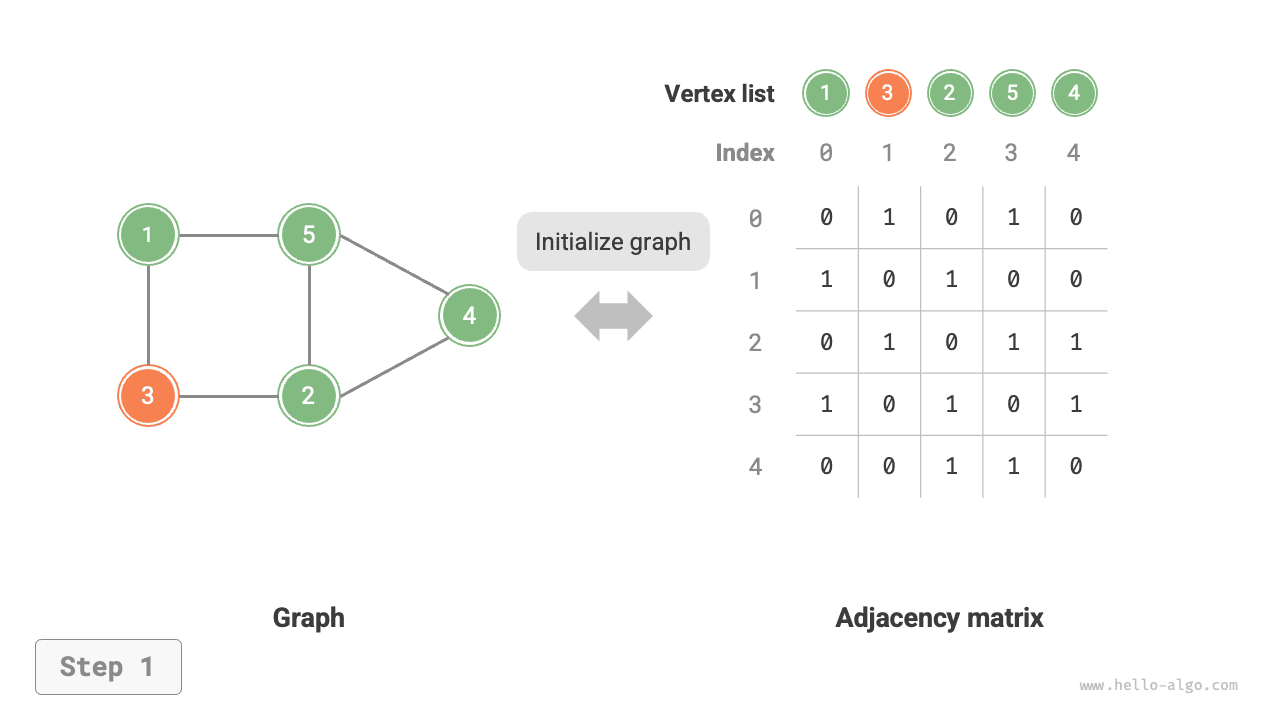
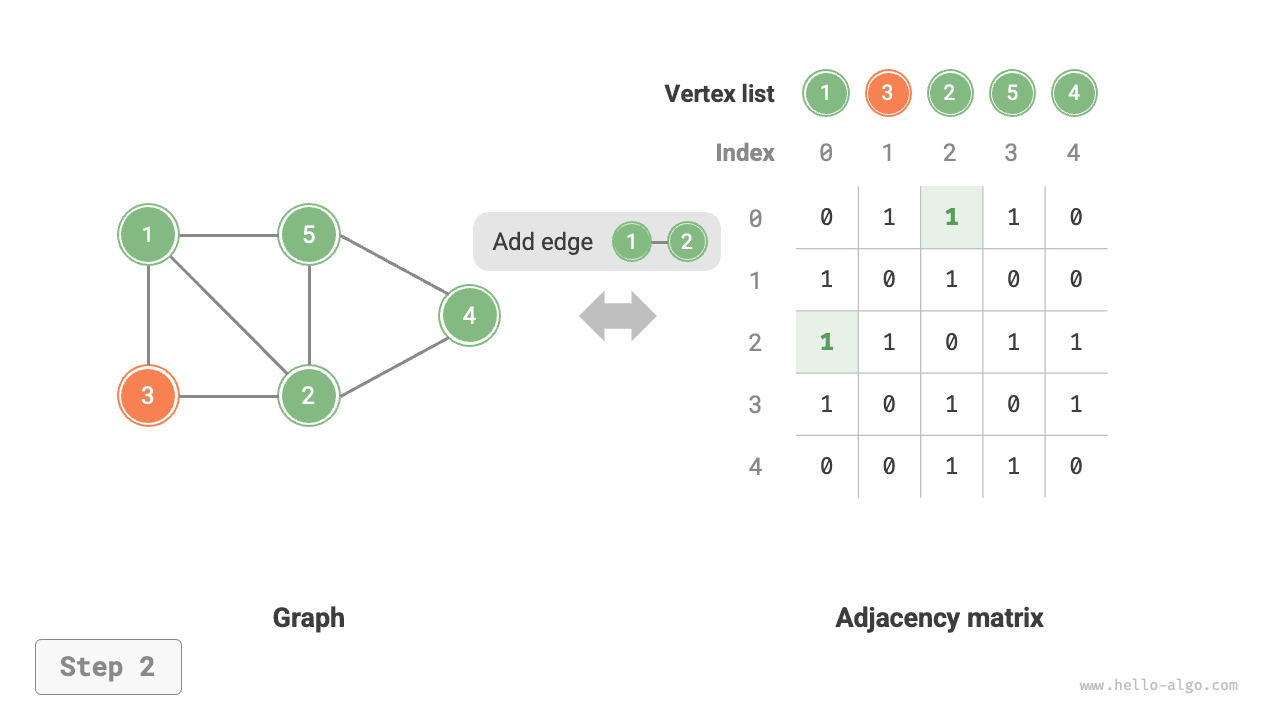
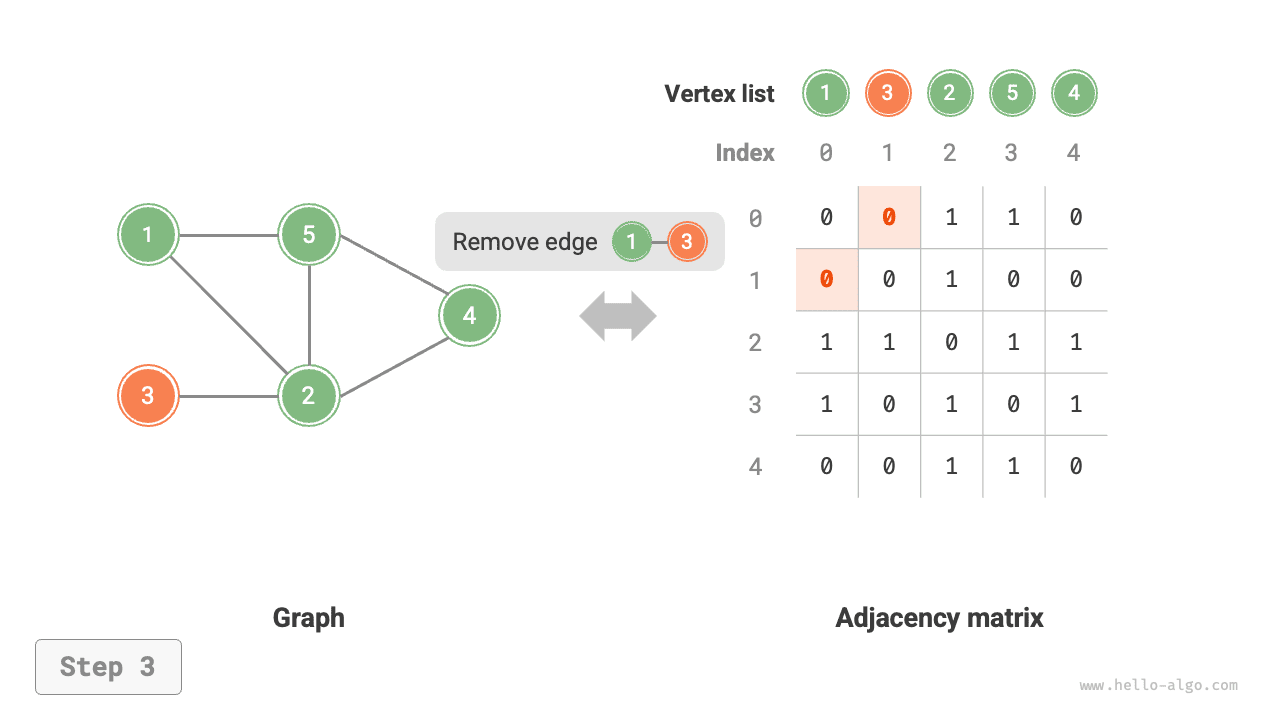
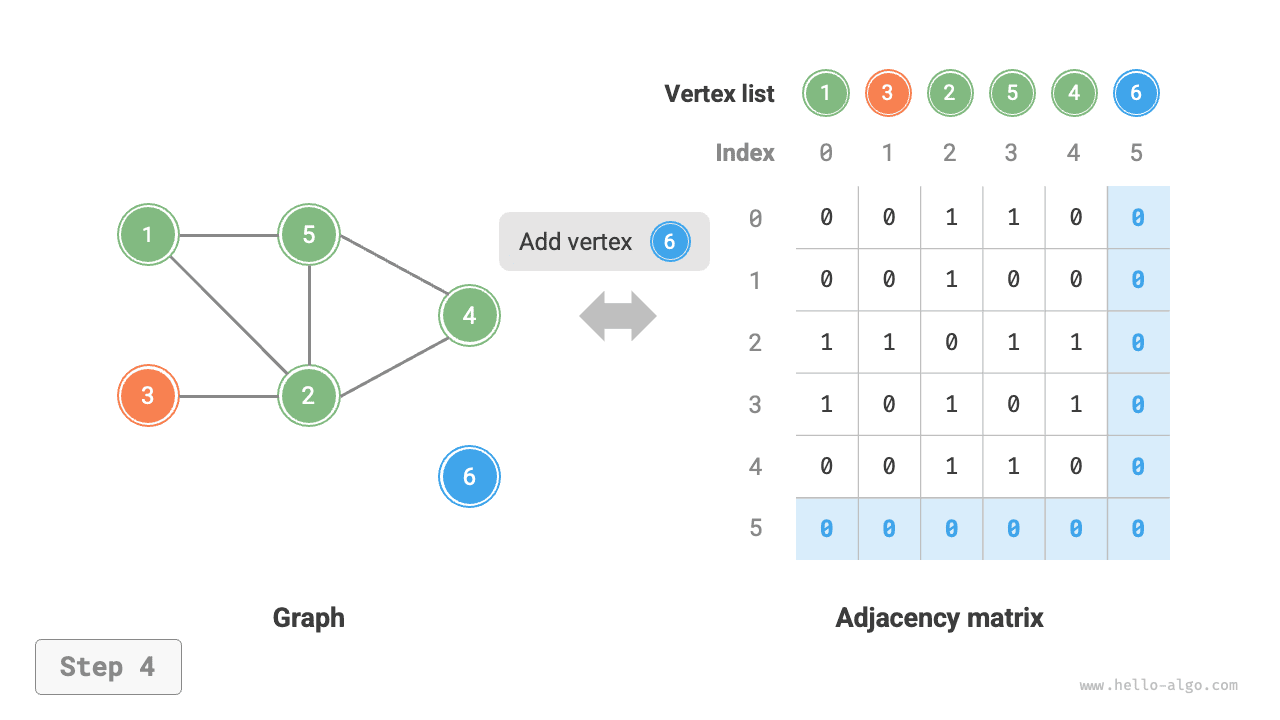
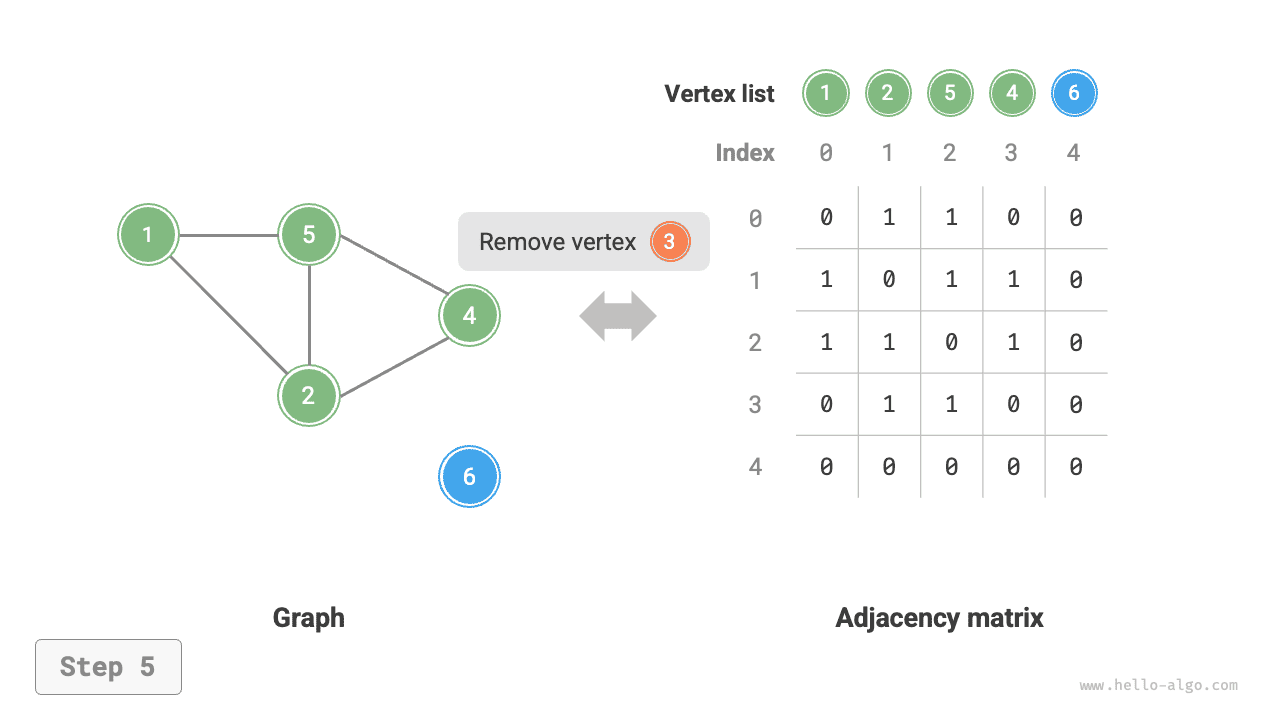
그림 9-7 인접 행렬의 초기화, 간선 추가와 삭제, 정점 추가와 삭제
다음은 인접 행렬로 그래프를 표현한 구현 코드다.
class GraphAdjMat:
    """인접 행렬로 구현한 무방향 그래프 클래스"""

    def __init__(self, vertices: list[int], edges: list[list[int]]):
        """생성자"""
        # 정점 리스트의 원소는 정점 값을, 인덱스는 정점 인덱스를 나타낸다
        self.vertices: list[int] = []
        # 인접 행렬의 행과 열 인덱스는 정점 인덱스에 해당한다
        self.adj_mat: list[list[int]] = []
        # 정점 추가
        for val in vertices:
            self.add_vertex(val)
        # 간선 추가
        # edges의 원소는 정점 인덱스, 즉 vertices 원소의 인덱스를 나타낸다
        for e in edges:
            self.add_edge(e[0], e[1])

    def size(self) -> int:
        """정점 개수 반환"""
        return len(self.vertices)

    def add_vertex(self, val: int):
        """정점 추가"""
        n = self.size()
        # 정점 리스트에 새 정점의 값을 추가한다
        self.vertices.append(val)
        # 인접 행렬에 행 하나를 추가한다
        new_row = [0] * n
        self.adj_mat.append(new_row)
        # 인접 행렬에 열 하나를 추가한다
        for row in self.adj_mat:
            row.append(0)

    def remove_vertex(self, index: int):
        """정점 삭제"""
        if index >= self.size():
            raise IndexError()
        # 정점 리스트에서 인덱스 index의 정점을 제거한다
        self.vertices.pop(index)
        # 인접 행렬에서 인덱스 index의 행을 삭제한다
        self.adj_mat.pop(index)
        # 인접 행렬에서 인덱스 index의 열을 삭제한다
        for row in self.adj_mat:
            row.pop(index)

    def add_edge(self, i: int, j: int):
        """간선 추가"""
        # 매개변수 i, j는 vertices 원소의 인덱스에 해당한다
        # 인덱스가 범위를 벗어나거나 서로 같은 경우를 처리한다
        if i < 0 or j < 0 or i >= self.size() or j >= self.size() or i == j:
            raise IndexError()
        # 무방향 그래프의 인접 행렬은 주대각선에 대해 대칭이며, (i, j) == (j, i)를 만족한다
        self.adj_mat[i][j] = 1
        self.adj_mat[j][i] = 1

    def remove_edge(self, i: int, j: int):
        """간선 삭제"""
        # 매개변수 i, j는 vertices 원소의 인덱스에 해당한다
        # 인덱스가 범위를 벗어나거나 서로 같은 경우를 처리한다
        if i < 0 or j < 0 or i >= self.size() or j >= self.size() or i == j:
            raise IndexError()
        self.adj_mat[i][j] = 0
        self.adj_mat[j][i] = 0

    def print(self):
        """인접 행렬 출력"""
        print("정점 리스트 =", self.vertices)
        print("인접 행렬 =")
        print_matrix(self.adj_mat)
/* 인접 행렬로 구현한 무방향 그래프 클래스 */
class GraphAdjMat {
    vector<int> vertices;       // 정점 리스트의 원소는 정점 값을, 인덱스는 정점 인덱스를 나타낸다
    vector<vector<int>> adjMat; // 인접 행렬의 행과 열 인덱스는 정점 인덱스에 해당한다

  public:
    /* 생성자 */
    GraphAdjMat(const vector<int> &vertices, const vector<vector<int>> &edges) {
        // 정점 추가
        for (int val : vertices) {
            addVertex(val);
        }
        // 간선 추가
        // edges의 원소는 정점 인덱스, 즉 vertices 원소의 인덱스를 나타낸다
        for (const vector<int> &edge : edges) {
            addEdge(edge[0], edge[1]);
        }
    }

    /* 정점 개수 반환 */
    int size() const {
        return vertices.size();
    }

    /* 정점 추가 */
    void addVertex(int val) {
        int n = size();
        // 정점 리스트에 새 정점의 값을 추가한다
        vertices.push_back(val);
        // 인접 행렬에 행 하나를 추가한다
        adjMat.emplace_back(vector<int>(n, 0));
        // 인접 행렬에 열 하나를 추가한다
        for (vector<int> &row : adjMat) {
            row.push_back(0);
        }
    }

    /* 정점 삭제 */
    void removeVertex(int index) {
        if (index >= size()) {
            throw out_of_range("정점이 존재하지 않는다");
        }
        // 정점 리스트에서 인덱스 index의 정점을 제거한다
        vertices.erase(vertices.begin() + index);
        // 인접 행렬에서 인덱스 index의 행을 삭제한다
        adjMat.erase(adjMat.begin() + index);
        // 인접 행렬에서 인덱스 index의 열을 삭제한다
        for (vector<int> &row : adjMat) {
            row.erase(row.begin() + index);
        }
    }

    /* 간선 추가 */
    // 매개변수 i, j는 vertices 원소의 인덱스에 해당한다
    void addEdge(int i, int j) {
        // 인덱스가 범위를 벗어나거나 서로 같은 경우를 처리한다
        if (i < 0 || j < 0 || i >= size() || j >= size() || i == j) {
            throw out_of_range("정점이 존재하지 않는다");
        }
        // 무방향 그래프의 인접 행렬은 주대각선에 대해 대칭이며, (i, j) == (j, i)를 만족한다
        adjMat[i][j] = 1;
        adjMat[j][i] = 1;
    }

    /* 간선 삭제 */
    // 매개변수 i, j는 vertices 원소의 인덱스에 해당한다
    void removeEdge(int i, int j) {
        // 인덱스가 범위를 벗어나거나 서로 같은 경우를 처리한다
        if (i < 0 || j < 0 || i >= size() || j >= size() || i == j) {
            throw out_of_range("정점이 존재하지 않는다");
        }
        adjMat[i][j] = 0;
        adjMat[j][i] = 0;
    }

    /* 인접 행렬 출력 */
    void print() {
        cout << "정점 리스트 = ";
        printVector(vertices);
        cout << "인접 행렬 =" << endl;
        printVectorMatrix(adjMat);
    }
};
/* 인접 행렬로 구현한 무방향 그래프 클래스 */
class GraphAdjMat {
    List<Integer> vertices; // 정점 리스트의 원소는 정점 값을, 인덱스는 정점 인덱스를 나타낸다
    List<List<Integer>> adjMat; // 인접 행렬의 행과 열 인덱스는 정점 인덱스에 해당한다

    /* 생성자 */
    public GraphAdjMat(int[] vertices, int[][] edges) {
        this.vertices = new ArrayList<>();
        this.adjMat = new ArrayList<>();
        // 정점 추가
        for (int val : vertices) {
            addVertex(val);
        }
        // 간선 추가
        // edges의 원소는 정점 인덱스, 즉 vertices 원소의 인덱스를 나타낸다
        for (int[] e : edges) {
            addEdge(e[0], e[1]);
        }
    }

    /* 정점 개수 반환 */
    public int size() {
        return vertices.size();
    }

    /* 정점 추가 */
    public void addVertex(int val) {
        int n = size();
        // 정점 리스트에 새 정점의 값을 추가한다
        vertices.add(val);
        // 인접 행렬에 행 하나를 추가한다
        List<Integer> newRow = new ArrayList<>(n);
        for (int j = 0; j < n; j++) {
            newRow.add(0);
        }
        adjMat.add(newRow);
        // 인접 행렬에 열 하나를 추가한다
        for (List<Integer> row : adjMat) {
            row.add(0);
        }
    }

    /* 정점 삭제 */
    public void removeVertex(int index) {
        if (index >= size())
            throw new IndexOutOfBoundsException();
        // 정점 리스트에서 인덱스 index의 정점을 제거한다
        vertices.remove(index);
        // 인접 행렬에서 인덱스 index의 행을 삭제한다
        adjMat.remove(index);
        // 인접 행렬에서 인덱스 index의 열을 삭제한다
        for (List<Integer> row : adjMat) {
            row.remove(index);
        }
    }

    /* 간선 추가 */
    // 매개변수 i, j는 vertices 원소의 인덱스에 해당한다
    public void addEdge(int i, int j) {
        // 인덱스가 범위를 벗어나거나 서로 같은 경우를 처리한다
        if (i < 0 || j < 0 || i >= size() || j >= size() || i == j)
            throw new IndexOutOfBoundsException();
        // 무방향 그래프의 인접 행렬은 주대각선에 대해 대칭이며, (i, j) == (j, i)를 만족한다
        adjMat.get(i).set(j, 1);
        adjMat.get(j).set(i, 1);
    }

    /* 간선 삭제 */
    // 매개변수 i, j는 vertices 원소의 인덱스에 해당한다
    public void removeEdge(int i, int j) {
        // 인덱스가 범위를 벗어나거나 서로 같은 경우를 처리한다
        if (i < 0 || j < 0 || i >= size() || j >= size() || i == j)
            throw new IndexOutOfBoundsException();
        adjMat.get(i).set(j, 0);
        adjMat.get(j).set(i, 0);
    }

    /* 인접 행렬 출력 */
    public void print() {
        System.out.print("정점 리스트 = ");
        System.out.println(vertices);
        System.out.println("인접 행렬 =");
        PrintUtil.printMatrix(adjMat);
    }
}
/* 인접 행렬로 구현한 무방향 그래프 클래스 */
class GraphAdjMat {
    List<int> vertices;     // 정점 리스트의 원소는 정점 값을, 인덱스는 정점 인덱스를 나타낸다
    List<List<int>> adjMat; // 인접 행렬의 행과 열 인덱스는 정점 인덱스에 해당한다

    /* 생성자 */
    public GraphAdjMat(int[] vertices, int[][] edges) {
        this.vertices = [];
        this.adjMat = [];
        // 정점 추가
        foreach (int val in vertices) {
            AddVertex(val);
        }
        // 간선 추가
        // edges의 원소는 정점 인덱스, 즉 vertices 원소의 인덱스를 나타낸다
        foreach (int[] e in edges) {
            AddEdge(e[0], e[1]);
        }
    }

    /* 정점 개수 반환 */
    int Size() {
        return vertices.Count;
    }

    /* 정점 추가 */
    public void AddVertex(int val) {
        int n = Size();
        // 정점 리스트에 새 정점의 값을 추가한다
        vertices.Add(val);
        // 인접 행렬에 행 하나를 추가한다
        List<int> newRow = new(n);
        for (int j = 0; j < n; j++) {
            newRow.Add(0);
        }
        adjMat.Add(newRow);
        // 인접 행렬에 열 하나를 추가한다
        foreach (List<int> row in adjMat) {
            row.Add(0);
        }
    }

    /* 정점 삭제 */
    public void RemoveVertex(int index) {
        if (index >= Size())
            throw new IndexOutOfRangeException();
        // 정점 리스트에서 인덱스 index의 정점을 제거한다
        vertices.RemoveAt(index);
        // 인접 행렬에서 인덱스 index의 행을 삭제한다
        adjMat.RemoveAt(index);
        // 인접 행렬에서 인덱스 index의 열을 삭제한다
        foreach (List<int> row in adjMat) {
            row.RemoveAt(index);
        }
    }

    /* 간선 추가 */
    // 매개변수 i, j는 vertices 원소의 인덱스에 해당한다
    public void AddEdge(int i, int j) {
        // 인덱스가 범위를 벗어나거나 서로 같은 경우를 처리한다
        if (i < 0 || j < 0 || i >= Size() || j >= Size() || i == j)
            throw new IndexOutOfRangeException();
        // 무방향 그래프의 인접 행렬은 주대각선에 대해 대칭이며, (i, j) == (j, i)를 만족한다
        adjMat[i][j] = 1;
        adjMat[j][i] = 1;
    }

    /* 간선 삭제 */
    // 매개변수 i, j는 vertices 원소의 인덱스에 해당한다
    public void RemoveEdge(int i, int j) {
        // 인덱스가 범위를 벗어나거나 서로 같은 경우를 처리한다
        if (i < 0 || j < 0 || i >= Size() || j >= Size() || i == j)
            throw new IndexOutOfRangeException();
        adjMat[i][j] = 0;
        adjMat[j][i] = 0;
    }

    /* 인접 행렬 출력 */
    public void Print() {
        Console.Write("정점 리스트 = ");
        PrintUtil.PrintList(vertices);
        Console.WriteLine("인접 행렬 =");
        PrintUtil.PrintMatrix(adjMat);
    }
}
/* 인접 행렬로 구현한 무방향 그래프 클래스 */
type graphAdjMat struct {
    // 정점 리스트의 원소는 정점 값을, 인덱스는 정점 인덱스를 나타낸다
    vertices []int
    // 인접 행렬의 행과 열 인덱스는 정점 인덱스에 해당한다
    adjMat [][]int
}

/* 생성자 */
func newGraphAdjMat(vertices []int, edges [][]int) *graphAdjMat {
    // 정점 추가
    n := len(vertices)
    adjMat := make([][]int, n)
    for i := range adjMat {
        adjMat[i] = make([]int, n)
    }
    // 그래프 초기화
    g := &graphAdjMat{
        vertices: vertices,
        adjMat:   adjMat,
    }
    // 간선 추가
    // edges의 원소는 정점 인덱스, 즉 vertices 원소의 인덱스를 나타낸다
    for i := range edges {
        g.addEdge(edges[i][0], edges[i][1])
    }
    return g
}

/* 정점 개수 반환 */
func (g *graphAdjMat) size() int {
    return len(g.vertices)
}

/* 정점 추가 */
func (g *graphAdjMat) addVertex(val int) {
    n := g.size()
    // 정점 리스트에 새 정점의 값을 추가한다
    g.vertices = append(g.vertices, val)
    // 인접 행렬에 행 하나를 추가한다
    newRow := make([]int, n)
    g.adjMat = append(g.adjMat, newRow)
    // 인접 행렬에 열 하나를 추가한다
    for i := range g.adjMat {
        g.adjMat[i] = append(g.adjMat[i], 0)
    }
}

/* 정점 삭제 */
func (g *graphAdjMat) removeVertex(index int) {
    if index >= g.size() {
        return
    }
    // 정점 리스트에서 인덱스 index의 정점을 제거한다
    g.vertices = append(g.vertices[:index], g.vertices[index+1:]...)
    // 인접 행렬에서 인덱스 index의 행을 삭제한다
    g.adjMat = append(g.adjMat[:index], g.adjMat[index+1:]...)
    // 인접 행렬에서 인덱스 index의 열을 삭제한다
    for i := range g.adjMat {
        g.adjMat[i] = append(g.adjMat[i][:index], g.adjMat[i][index+1:]...)
    }
}

/* 간선 추가 */
// 매개변수 i, j는 vertices 원소의 인덱스에 해당한다
func (g *graphAdjMat) addEdge(i, j int) {
    // 인덱스가 범위를 벗어나거나 서로 같은 경우를 처리한다
    if i < 0 || j < 0 || i >= g.size() || j >= g.size() || i == j {
        fmt.Errorf("%s", "인덱스가 범위를 벗어났다")
    }
    // 무방향 그래프의 인접 행렬은 주대각선에 대해 대칭이며, (i, j) == (j, i)를 만족한다
    g.adjMat[i][j] = 1
    g.adjMat[j][i] = 1
}

/* 간선 삭제 */
// 매개변수 i, j는 vertices 원소의 인덱스에 해당한다
func (g *graphAdjMat) removeEdge(i, j int) {
    // 인덱스가 범위를 벗어나거나 서로 같은 경우를 처리한다
    if i < 0 || j < 0 || i >= g.size() || j >= g.size() || i == j {
        fmt.Errorf("%s", "인덱스가 범위를 벗어났다")
    }
    g.adjMat[i][j] = 0
    g.adjMat[j][i] = 0
}

/* 인접 행렬 출력 */
func (g *graphAdjMat) print() {
    fmt.Printf("\t정점 리스트 = %v\n", g.vertices)
    fmt.Printf("\t인접 행렬 = \n")
    for i := range g.adjMat {
        fmt.Printf("\t\t\t%v\n", g.adjMat[i])
    }
}
/* 인접 행렬로 구현한 무방향 그래프 클래스 */
class GraphAdjMat {
    private var vertices: [Int] // 정점 리스트의 원소는 정점 값을, 인덱스는 정점 인덱스를 나타낸다
    private var adjMat: [[Int]] // 인접 행렬의 행과 열 인덱스는 정점 인덱스에 해당한다

    /* 생성자 */
    init(vertices: [Int], edges: [[Int]]) {
        self.vertices = []
        adjMat = []
        // 정점 추가
        for val in vertices {
            addVertex(val: val)
        }
        // 간선 추가
        // edges의 원소는 정점 인덱스, 즉 vertices 원소의 인덱스를 나타낸다
        for e in edges {
            addEdge(i: e[0], j: e[1])
        }
    }

    /* 정점 개수 반환 */
    func size() -> Int {
        vertices.count
    }

    /* 정점 추가 */
    func addVertex(val: Int) {
        let n = size()
        // 정점 리스트에 새 정점의 값을 추가한다
        vertices.append(val)
        // 인접 행렬에 행 하나를 추가한다
        let newRow = Array(repeating: 0, count: n)
        adjMat.append(newRow)
        // 인접 행렬에 열 하나를 추가한다
        for i in adjMat.indices {
            adjMat[i].append(0)
        }
    }

    /* 정점 삭제 */
    func removeVertex(index: Int) {
        if index >= size() {
            fatalError("범위를 벗어남")
        }
        // 정점 리스트에서 인덱스 index의 정점을 제거한다
        vertices.remove(at: index)
        // 인접 행렬에서 인덱스 index의 행을 삭제한다
        adjMat.remove(at: index)
        // 인접 행렬에서 인덱스 index의 열을 삭제한다
        for i in adjMat.indices {
            adjMat[i].remove(at: index)
        }
    }

    /* 간선 추가 */
    // 매개변수 i, j는 vertices 원소의 인덱스에 해당한다
    func addEdge(i: Int, j: Int) {
        // 인덱스가 범위를 벗어나거나 서로 같은 경우를 처리한다
        if i < 0 || j < 0 || i >= size() || j >= size() || i == j {
            fatalError("범위를 벗어남")
        }
        // 무방향 그래프의 인접 행렬은 주대각선에 대해 대칭이며, (i, j) == (j, i)를 만족한다
        adjMat[i][j] = 1
        adjMat[j][i] = 1
    }

    /* 간선 삭제 */
    // 매개변수 i, j는 vertices 원소의 인덱스에 해당한다
    func removeEdge(i: Int, j: Int) {
        // 인덱스가 범위를 벗어나거나 서로 같은 경우를 처리한다
        if i < 0 || j < 0 || i >= size() || j >= size() || i == j {
            fatalError("범위를 벗어남")
        }
        adjMat[i][j] = 0
        adjMat[j][i] = 0
    }

    /* 인접 행렬 출력 */
    func print() {
        Swift.print("정점 리스트 = ", terminator: "")
        Swift.print(vertices)
        Swift.print("인접 행렬 =")
        PrintUtil.printMatrix(matrix: adjMat)
    }
}
/* 인접 행렬로 구현한 무방향 그래프 클래스 */
class GraphAdjMat {
    vertices; // 정점 리스트의 원소는 정점 값을, 인덱스는 정점 인덱스를 나타낸다
    adjMat; // 인접 행렬의 행과 열 인덱스는 정점 인덱스에 해당한다

    /* 생성자 */
    constructor(vertices, edges) {
        this.vertices = [];
        this.adjMat = [];
        // 정점 추가
        for (const val of vertices) {
            this.addVertex(val);
        }
        // 간선 추가
        // edges의 원소는 정점 인덱스, 즉 vertices 원소의 인덱스를 나타낸다
        for (const e of edges) {
            this.addEdge(e[0], e[1]);
        }
    }

    /* 정점 개수 반환 */
    size() {
        return this.vertices.length;
    }

    /* 정점 추가 */
    addVertex(val) {
        const n = this.size();
        // 정점 리스트에 새 정점의 값을 추가한다
        this.vertices.push(val);
        // 인접 행렬에 행 하나를 추가한다
        const newRow = [];
        for (let j = 0; j < n; j++) {
            newRow.push(0);
        }
        this.adjMat.push(newRow);
        // 인접 행렬에 열 하나를 추가한다
        for (const row of this.adjMat) {
            row.push(0);
        }
    }

    /* 정점 삭제 */
    removeVertex(index) {
        if (index >= this.size()) {
            throw new RangeError('인덱스가 범위를 벗어났다');
        }
        // 정점 리스트에서 인덱스 index의 정점을 제거한다
        this.vertices.splice(index, 1);

        // 인접 행렬에서 인덱스 index의 행을 삭제한다
        this.adjMat.splice(index, 1);
        // 인접 행렬에서 인덱스 index의 열을 삭제한다
        for (const row of this.adjMat) {
            row.splice(index, 1);
        }
    }

    /* 간선 추가 */
    // 매개변수 i, j는 vertices 원소의 인덱스에 해당한다
    addEdge(i, j) {
        // 인덱스가 범위를 벗어나거나 서로 같은 경우를 처리한다
        if (i < 0 || j < 0 || i >= this.size() || j >= this.size() || i === j) {
            throw new RangeError('인덱스가 범위를 벗어났다');
        }
        // 무방향 그래프의 인접 행렬은 주대각선을 기준으로 대칭이므로 (i, j) === (j, i)를 만족한다
        this.adjMat[i][j] = 1;
        this.adjMat[j][i] = 1;
    }

    /* 간선 삭제 */
    // 매개변수 i, j는 vertices 원소의 인덱스에 해당한다
    removeEdge(i, j) {
        // 인덱스가 범위를 벗어나거나 서로 같은 경우를 처리한다
        if (i < 0 || j < 0 || i >= this.size() || j >= this.size() || i === j) {
            throw new RangeError('인덱스가 범위를 벗어났다');
        }
        this.adjMat[i][j] = 0;
        this.adjMat[j][i] = 0;
    }

    /* 인접 행렬 출력 */
    print() {
        console.log('정점 리스트 = ', this.vertices);
        console.log('인접 행렬 =', this.adjMat);
    }
}
/* 인접 행렬로 구현한 무방향 그래프 클래스 */
class GraphAdjMat {
    vertices: number[]; // 정점 리스트의 원소는 정점 값을, 인덱스는 정점 인덱스를 나타낸다
    adjMat: number[][]; // 인접 행렬의 행과 열 인덱스는 정점 인덱스에 해당한다

    /* 생성자 */
    constructor(vertices: number[], edges: number[][]) {
        this.vertices = [];
        this.adjMat = [];
        // 정점 추가
        for (const val of vertices) {
            this.addVertex(val);
        }
        // 간선 추가
        // edges의 원소는 정점 인덱스, 즉 vertices 원소의 인덱스를 나타낸다
        for (const e of edges) {
            this.addEdge(e[0], e[1]);
        }
    }

    /* 정점 개수 반환 */
    size(): number {
        return this.vertices.length;
    }

    /* 정점 추가 */
    addVertex(val: number): void {
        const n: number = this.size();
        // 정점 리스트에 새 정점의 값을 추가한다
        this.vertices.push(val);
        // 인접 행렬에 행 하나를 추가한다
        const newRow: number[] = [];
        for (let j: number = 0; j < n; j++) {
            newRow.push(0);
        }
        this.adjMat.push(newRow);
        // 인접 행렬에 열 하나를 추가한다
        for (const row of this.adjMat) {
            row.push(0);
        }
    }

    /* 정점 삭제 */
    removeVertex(index: number): void {
        if (index >= this.size()) {
            throw new RangeError('인덱스가 범위를 벗어났다');
        }
        // 정점 리스트에서 인덱스 index의 정점을 제거한다
        this.vertices.splice(index, 1);

        // 인접 행렬에서 인덱스 index의 행을 삭제한다
        this.adjMat.splice(index, 1);
        // 인접 행렬에서 인덱스 index의 열을 삭제한다
        for (const row of this.adjMat) {
            row.splice(index, 1);
        }
    }

    /* 간선 추가 */
    // 매개변수 i, j는 vertices 원소의 인덱스에 해당한다
    addEdge(i: number, j: number): void {
        // 인덱스가 범위를 벗어나거나 서로 같은 경우를 처리한다
        if (i < 0 || j < 0 || i >= this.size() || j >= this.size() || i === j) {
            throw new RangeError('인덱스가 범위를 벗어났다');
        }
        // 무방향 그래프의 인접 행렬은 주대각선을 기준으로 대칭이므로 (i, j) === (j, i)를 만족한다
        this.adjMat[i][j] = 1;
        this.adjMat[j][i] = 1;
    }

    /* 간선 삭제 */
    // 매개변수 i, j는 vertices 원소의 인덱스에 해당한다
    removeEdge(i: number, j: number): void {
        // 인덱스가 범위를 벗어나거나 서로 같은 경우를 처리한다
        if (i < 0 || j < 0 || i >= this.size() || j >= this.size() || i === j) {
            throw new RangeError('인덱스가 범위를 벗어났다');
        }
        this.adjMat[i][j] = 0;
        this.adjMat[j][i] = 0;
    }

    /* 인접 행렬 출력 */
    print(): void {
        console.log('정점 리스트 = ', this.vertices);
        console.log('인접 행렬 =', this.adjMat);
    }
}
/* 인접 행렬로 구현한 무방향 그래프 클래스 */
class GraphAdjMat {
  List<int> vertices = []; // 정점 원소는 정점 값을, 인덱스는 정점 인덱스를 나타낸다
  List<List<int>> adjMat = []; //인접 행렬의 행과 열 인덱스는 정점 인덱스에 해당한다

  /* 생성자 */
  GraphAdjMat(List<int> vertices, List<List<int>> edges) {
    this.vertices = [];
    this.adjMat = [];
    // 정점 추가
    for (int val in vertices) {
      addVertex(val);
    }
    // 간선 추가
    // edges의 원소는 정점 인덱스, 즉 vertices 원소의 인덱스를 나타낸다
    for (List<int> e in edges) {
      addEdge(e[0], e[1]);
    }
  }

  /* 정점 개수 반환 */
  int size() {
    return vertices.length;
  }

  /* 정점 추가 */
  void addVertex(int val) {
    int n = size();
    // 정점 리스트에 새 정점의 값을 추가한다
    vertices.add(val);
    // 인접 행렬에 행 하나를 추가한다
    List<int> newRow = List.filled(n, 0, growable: true);
    adjMat.add(newRow);
    // 인접 행렬에 열 하나를 추가한다
    for (List<int> row in adjMat) {
      row.add(0);
    }
  }

  /* 정점 삭제 */
  void removeVertex(int index) {
    if (index >= size()) {
      throw IndexError;
    }
    // 정점 리스트에서 인덱스 index의 정점을 제거한다
    vertices.removeAt(index);
    // 인접 행렬에서 인덱스 index의 행을 삭제한다
    adjMat.removeAt(index);
    // 인접 행렬에서 인덱스 index의 열을 삭제한다
    for (List<int> row in adjMat) {
      row.removeAt(index);
    }
  }

  /* 간선 추가 */
  // 매개변수 i, j는 vertices 원소의 인덱스에 해당한다
  void addEdge(int i, int j) {
    // 인덱스가 범위를 벗어나거나 서로 같은 경우를 처리한다
    if (i < 0 || j < 0 || i >= size() || j >= size() || i == j) {
      throw IndexError;
    }
    // 무방향 그래프의 인접 행렬은 주대각선에 대해 대칭이며, (i, j) == (j, i)를 만족한다
    adjMat[i][j] = 1;
    adjMat[j][i] = 1;
  }

  /* 간선 삭제 */
  // 매개변수 i, j는 vertices 원소의 인덱스에 해당한다
  void removeEdge(int i, int j) {
    // 인덱스가 범위를 벗어나거나 서로 같은 경우를 처리한다
    if (i < 0 || j < 0 || i >= size() || j >= size() || i == j) {
      throw IndexError;
    }
    adjMat[i][j] = 0;
    adjMat[j][i] = 0;
  }

  /* 인접 행렬 출력 */
  void printAdjMat() {
    print("정점 리스트 = $vertices");
    print("인접 행렬 = ");
    printMatrix(adjMat);
  }
}
/* 인접 행렬로 구현한 무방향 그래프 자료형 */
pub struct GraphAdjMat {
    // 정점 리스트의 원소는 정점 값을, 인덱스는 정점 인덱스를 나타낸다
    pub vertices: Vec<i32>,
    // 인접 행렬의 행과 열 인덱스는 정점 인덱스에 해당한다
    pub adj_mat: Vec<Vec<i32>>,
}

impl GraphAdjMat {
    /* 생성자 */
    pub fn new(vertices: Vec<i32>, edges: Vec<[usize; 2]>) -> Self {
        let mut graph = GraphAdjMat {
            vertices: vec![],
            adj_mat: vec![],
        };
        // 정점 추가
        for val in vertices {
            graph.add_vertex(val);
        }
        // 간선 추가
        // edges의 원소는 정점 인덱스, 즉 vertices 원소의 인덱스를 나타낸다
        for edge in edges {
            graph.add_edge(edge[0], edge[1])
        }

        graph
    }

    /* 정점 개수 반환 */
    pub fn size(&self) -> usize {
        self.vertices.len()
    }

    /* 정점 추가 */
    pub fn add_vertex(&mut self, val: i32) {
        let n = self.size();
        // 정점 리스트에 새 정점의 값을 추가한다
        self.vertices.push(val);
        // 인접 행렬에 행 하나를 추가한다
        self.adj_mat.push(vec![0; n]);
        // 인접 행렬에 열 하나를 추가한다
        for row in self.adj_mat.iter_mut() {
            row.push(0);
        }
    }

    /* 정점 삭제 */
    pub fn remove_vertex(&mut self, index: usize) {
        if index >= self.size() {
            panic!("인덱스 오류")
        }
        // 정점 리스트에서 인덱스 index의 정점을 제거한다
        self.vertices.remove(index);
        // 인접 행렬에서 인덱스 index의 행을 삭제한다
        self.adj_mat.remove(index);
        // 인접 행렬에서 인덱스 index의 열을 삭제한다
        for row in self.adj_mat.iter_mut() {
            row.remove(index);
        }
    }

    /* 간선 추가 */
    pub fn add_edge(&mut self, i: usize, j: usize) {
        // 매개변수 i, j는 vertices 원소의 인덱스에 해당한다
        // 인덱스가 범위를 벗어나거나 서로 같은 경우를 처리한다
        if i >= self.size() || j >= self.size() || i == j {
            panic!("인덱스 오류")
        }
        // 무방향 그래프의 인접 행렬은 주대각선에 대해 대칭이며, (i, j) == (j, i)를 만족한다
        self.adj_mat[i][j] = 1;
        self.adj_mat[j][i] = 1;
    }

    /* 간선 삭제 */
    // 매개변수 i, j는 vertices 원소의 인덱스에 해당한다
    pub fn remove_edge(&mut self, i: usize, j: usize) {
        // 매개변수 i, j는 vertices 원소의 인덱스에 해당한다
        // 인덱스가 범위를 벗어나거나 서로 같은 경우를 처리한다
        if i >= self.size() || j >= self.size() || i == j {
            panic!("인덱스 오류")
        }
        self.adj_mat[i][j] = 0;
        self.adj_mat[j][i] = 0;
    }

    /* 인접 행렬 출력 */
    pub fn print(&self) {
        println!("정점 리스트 = {:?}", self.vertices);
        println!("인접 행렬 =");
        println!("[");
        for row in &self.adj_mat {
            println!("  {:?},", row);
        }
        println!("]")
    }
}
/* 인접 행렬로 구현한 무방향 그래프 구조체 */
typedef struct {
    int vertices[MAX_SIZE];
    int adjMat[MAX_SIZE][MAX_SIZE];
    int size;
} GraphAdjMat;

/* 생성자 */
GraphAdjMat *newGraphAdjMat() {
    GraphAdjMat *graph = (GraphAdjMat *)malloc(sizeof(GraphAdjMat));
    graph->size = 0;
    for (int i = 0; i < MAX_SIZE; i++) {
        for (int j = 0; j < MAX_SIZE; j++) {
            graph->adjMat[i][j] = 0;
        }
    }
    return graph;
}

/* 소멸자 */
void delGraphAdjMat(GraphAdjMat *graph) {
    free(graph);
}

/* 정점 추가 */
void addVertex(GraphAdjMat *graph, int val) {
    if (graph->size == MAX_SIZE) {
        fprintf(stderr, "그래프의 정점 개수가 최댓값에 도달했다\n");
        return;
    }
    // n번째 정점을 추가하고 n번째 행과 열을 0으로 설정한다
    int n = graph->size;
    graph->vertices[n] = val;
    for (int i = 0; i <= n; i++) {
        graph->adjMat[n][i] = graph->adjMat[i][n] = 0;
    }
    graph->size++;
}

/* 정점 삭제 */
void removeVertex(GraphAdjMat *graph, int index) {
    if (index < 0 || index >= graph->size) {
        fprintf(stderr, "정점 인덱스가 범위를 벗어났다\n");
        return;
    }
    // 정점 리스트에서 인덱스 index의 정점을 제거한다
    for (int i = index; i < graph->size - 1; i++) {
        graph->vertices[i] = graph->vertices[i + 1];
    }
    // 인접 행렬에서 인덱스 index의 행을 삭제한다
    for (int i = index; i < graph->size - 1; i++) {
        for (int j = 0; j < graph->size; j++) {
            graph->adjMat[i][j] = graph->adjMat[i + 1][j];
        }
    }
    // 인접 행렬에서 인덱스 index의 열을 삭제한다
    for (int i = 0; i < graph->size; i++) {
        for (int j = index; j < graph->size - 1; j++) {
            graph->adjMat[i][j] = graph->adjMat[i][j + 1];
        }
    }
    graph->size--;
}

/* 간선 추가 */
// 매개변수 i, j는 vertices 원소의 인덱스에 해당한다
void addEdge(GraphAdjMat *graph, int i, int j) {
    if (i < 0 || j < 0 || i >= graph->size || j >= graph->size || i == j) {
        fprintf(stderr, "간선 인덱스가 범위를 벗어나거나 서로 같다\n");
        return;
    }
    graph->adjMat[i][j] = 1;
    graph->adjMat[j][i] = 1;
}

/* 간선 삭제 */
// 매개변수 i, j는 vertices 원소의 인덱스에 해당한다
void removeEdge(GraphAdjMat *graph, int i, int j) {
    if (i < 0 || j < 0 || i >= graph->size || j >= graph->size || i == j) {
        fprintf(stderr, "간선 인덱스가 범위를 벗어나거나 서로 같다\n");
        return;
    }
    graph->adjMat[i][j] = 0;
    graph->adjMat[j][i] = 0;
}

/* 인접 행렬 출력 */
void printGraphAdjMat(GraphAdjMat *graph) {
    printf("정점 리스트 = ");
    printArray(graph->vertices, graph->size);
    printf("인접 행렬 =\n");
    for (int i = 0; i < graph->size; i++) {
        printArray(graph->adjMat[i], graph->size);
    }
}
/* 인접 행렬로 구현한 무방향 그래프 클래스 */
class GraphAdjMat(vertices: IntArray, edges: Array<IntArray>) {
    val vertices = mutableListOf<Int>() // 정점 리스트의 원소는 정점 값을, 인덱스는 정점 인덱스를 나타낸다
    val adjMat = mutableListOf<MutableList<Int>>() // 인접 행렬의 행과 열 인덱스는 정점 인덱스에 해당한다

    /* 생성자 */
    init {
        // 정점 추가
        for (vertex in vertices) {
            addVertex(vertex)
        }
        // 간선 추가
        // edges의 원소는 정점 인덱스, 즉 vertices 원소의 인덱스를 나타낸다
        for (edge in edges) {
            addEdge(edge[0], edge[1])
        }
    }

    /* 정점 개수 반환 */
    fun size(): Int {
        return vertices.size
    }

    /* 정점 추가 */
    fun addVertex(_val: Int) {
        val n = size()
        // 정점 리스트에 새 정점의 값을 추가한다
        vertices.add(_val)
        // 인접 행렬에 행 하나를 추가한다
        val newRow = mutableListOf<Int>()
        for (j in 0..<n) {
            newRow.add(0)
        }
        adjMat.add(newRow)
        // 인접 행렬에 열 하나를 추가한다
        for (row in adjMat) {
            row.add(0)
        }
    }

    /* 정점 삭제 */
    fun removeVertex(index: Int) {
        if (index >= size())
            throw IndexOutOfBoundsException()
        // 정점 리스트에서 인덱스 index의 정점을 제거한다
        vertices.removeAt(index)
        // 인접 행렬에서 인덱스 index의 행을 삭제한다
        adjMat.removeAt(index)
        // 인접 행렬에서 인덱스 index의 열을 삭제한다
        for (row in adjMat) {
            row.removeAt(index)
        }
    }

    /* 간선 추가 */
    // 매개변수 i, j는 vertices 원소의 인덱스에 해당한다
    fun addEdge(i: Int, j: Int) {
        // 인덱스가 범위를 벗어나거나 서로 같은 경우를 처리한다
        if (i < 0 || j < 0 || i >= size() || j >= size() || i == j)
            throw IndexOutOfBoundsException()
        // 무방향 그래프의 인접 행렬은 주대각선에 대해 대칭이며, (i, j) == (j, i)를 만족한다
        adjMat[i][j] = 1
        adjMat[j][i] = 1
    }

    /* 간선 삭제 */
    // 매개변수 i, j는 vertices 원소의 인덱스에 해당한다
    fun removeEdge(i: Int, j: Int) {
        // 인덱스가 범위를 벗어나거나 서로 같은 경우를 처리한다
        if (i < 0 || j < 0 || i >= size() || j >= size() || i == j)
            throw IndexOutOfBoundsException()
        adjMat[i][j] = 0
        adjMat[j][i] = 0
    }

    /* 인접 행렬 출력 */
    fun print() {
        print("정점 리스트 = ")
        println(vertices)
        println("인접 행렬 =")
        printMatrix(adjMat)
    }
}
### 인접 행렬로 구현한 무방향 그래프 클래스 ###
class GraphAdjMat
  def initialize(vertices, edges)
    ### 생성자 ###
    # 정점 리스트의 원소는 정점 값을, 인덱스는 정점 인덱스를 나타낸다
    @vertices = []
    # 인접 행렬의 행과 열 인덱스는 정점 인덱스에 해당한다
    @adj_mat = []
    # 정점 추가
    vertices.each { |val| add_vertex(val) }
    # 간선 추가
    # edges의 원소는 정점 인덱스, 즉 vertices 원소의 인덱스를 나타낸다
    edges.each { |e| add_edge(e[0], e[1]) }
  end

  ### 정점 개수 반환 ###
  def size
    @vertices.length
  end

  ### 정점 추가 ###
  def add_vertex(val)
    n = size
    # 정점 리스트에 새 정점의 값을 추가한다
    @vertices << val
    # 인접 행렬에 행 하나를 추가한다
    new_row = Array.new(n, 0)
    @adj_mat << new_row
    # 인접 행렬에 열 하나를 추가한다
    @adj_mat.each { |row| row << 0 }
  end

  ### 정점 삭제 ###
  def remove_vertex(index)
    raise IndexError if index >= size

    # 정점 리스트에서 인덱스 index의 정점을 제거한다
    @vertices.delete_at(index)
    # 인접 행렬에서 인덱스 index의 행을 삭제한다
    @adj_mat.delete_at(index)
    # 인접 행렬에서 인덱스 index의 열을 삭제한다
    @adj_mat.each { |row| row.delete_at(index) }
  end

  ### 간선 추가 ###
  def add_edge(i, j)
    # 매개변수 i, j는 vertices 원소의 인덱스에 해당한다
    # 인덱스가 범위를 벗어나거나 서로 같은 경우를 처리한다
    if i < 0 || j < 0 || i >= size || j >= size || i == j
      raise IndexError
    end
    # 무방향 그래프의 인접 행렬은 주대각선에 대해 대칭이며, (i, j) == (j, i)를 만족한다
    @adj_mat[i][j] = 1
    @adj_mat[j][i] = 1
  end

  ### 간선 삭제 ###
  def remove_edge(i, j)
    # 매개변수 i, j는 vertices 원소의 인덱스에 해당한다
    # 인덱스가 범위를 벗어나거나 서로 같은 경우를 처리한다
    if i < 0 || j < 0 || i >= size || j >= size || i == j
      raise IndexError
    end
    @adj_mat[i][j] = 0
    @adj_mat[j][i] = 0
  end

  ### 인접 행렬 출력 ###
  def __print__
    puts "정점 리스트 = #{@vertices}"
    puts '인접 행렬 ='
    print_matrix(@adj_mat)
  end
end
코드 시각화
9.2.2 인접 리스트 기반 구현
무방향 그래프의 전체 정점 수가 \(n\), 전체 간선 수가 \(m\)이라면 아래 그림(9-8)의 방법으로 각 연산을 구현할 수 있다.
- 간선 추가: 해당 정점에 대응하는 연결 리스트 끝에 간선을 추가한다. \(O(1)\) 시간이 걸린다. 무방향 그래프이므로 두 방향의 간선을 함께 추가해야 한다.
- 간선 삭제: 해당 정점에 대응하는 연결 리스트에서 지정한 간선을 찾아 삭제한다. \(O(m)\) 시간이 걸린다. 무방향 그래프에서는 두 방향의 간선을 함께 삭제해야 한다.
- 정점 추가: 인접 리스트에 연결 리스트 하나를 추가하고 새 정점을 그 연결 리스트의 머리 노드로 둔다. \(O(1)\) 시간이 걸린다.
- 정점 삭제: 인접 리스트 전체를 순회하며 지정한 정점이 포함된 모든 간선을 삭제한다. \(O(n + m)\) 시간이 걸린다.
- 초기화: 인접 리스트에 정점 \(n\) 개와 간선 \(2m\) 개를 만든다. \(O(n + m)\) 시간이 걸린다.
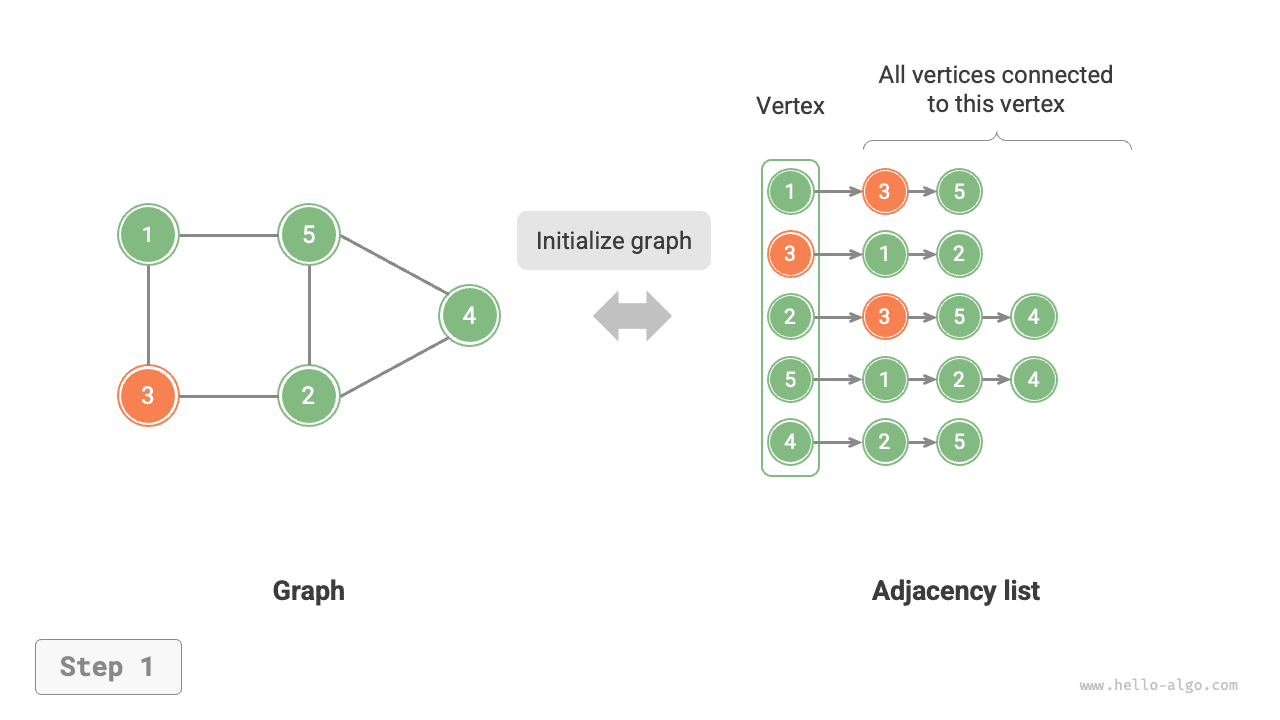
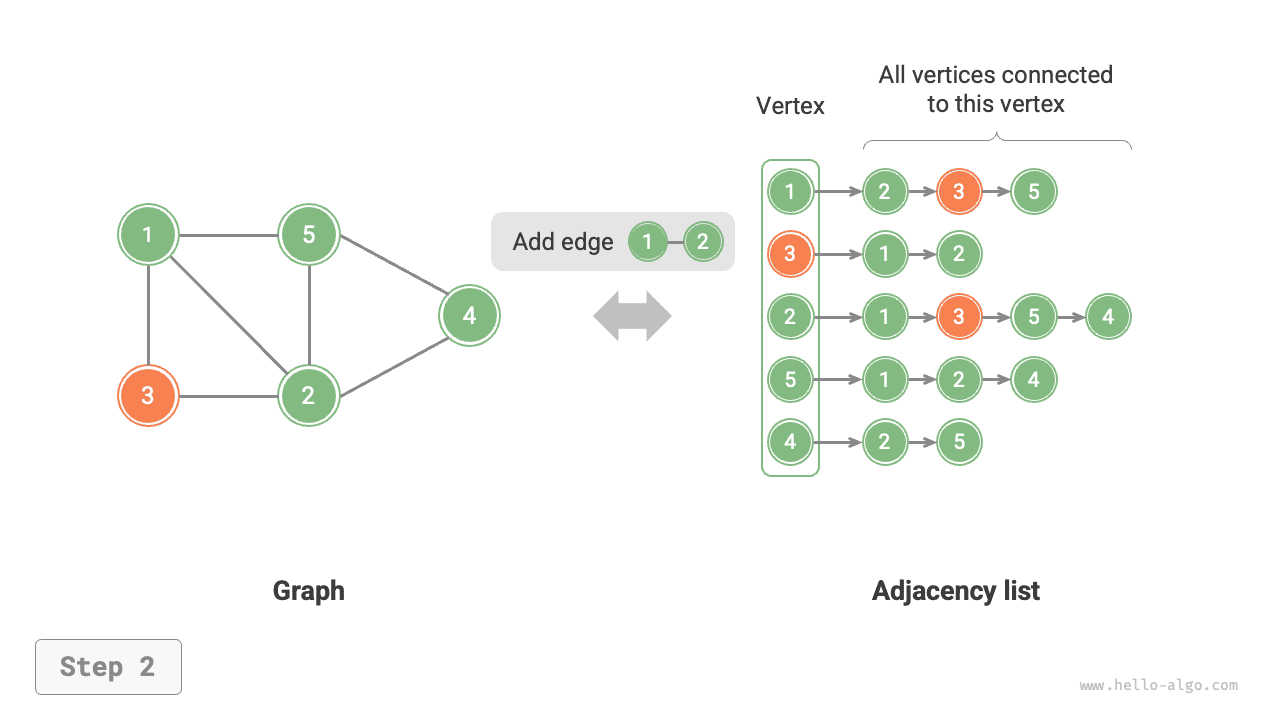
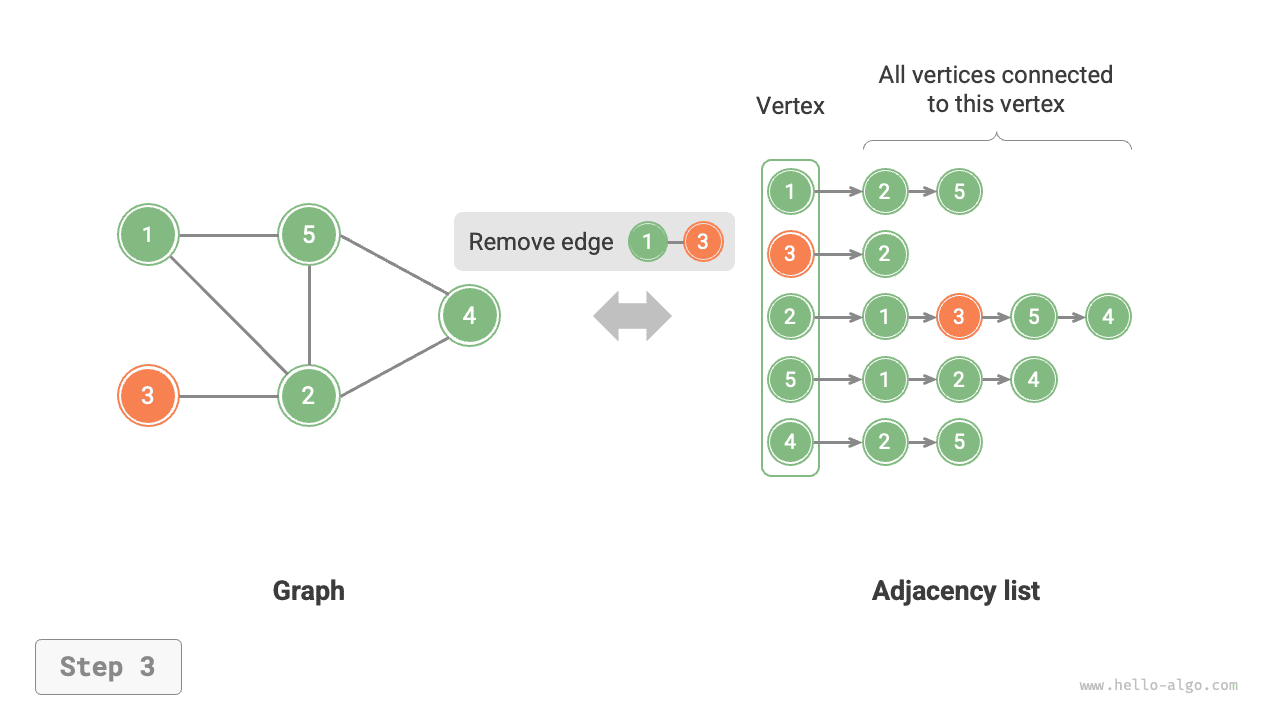
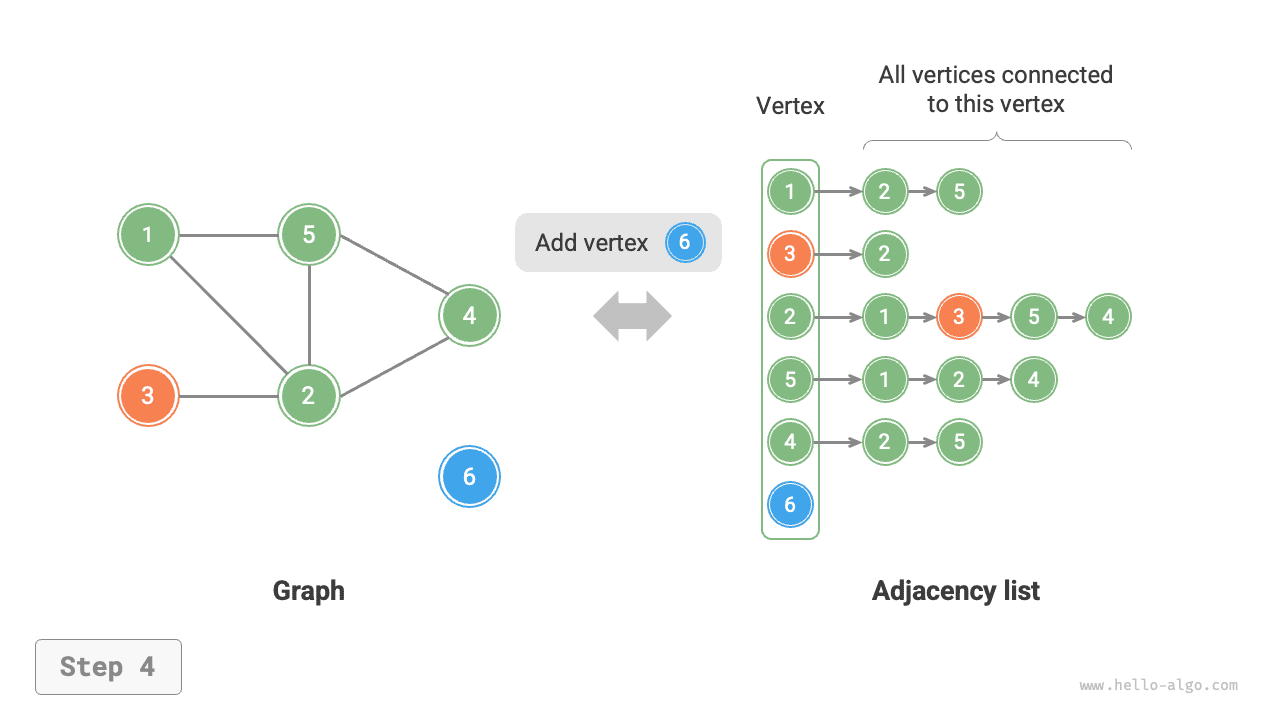
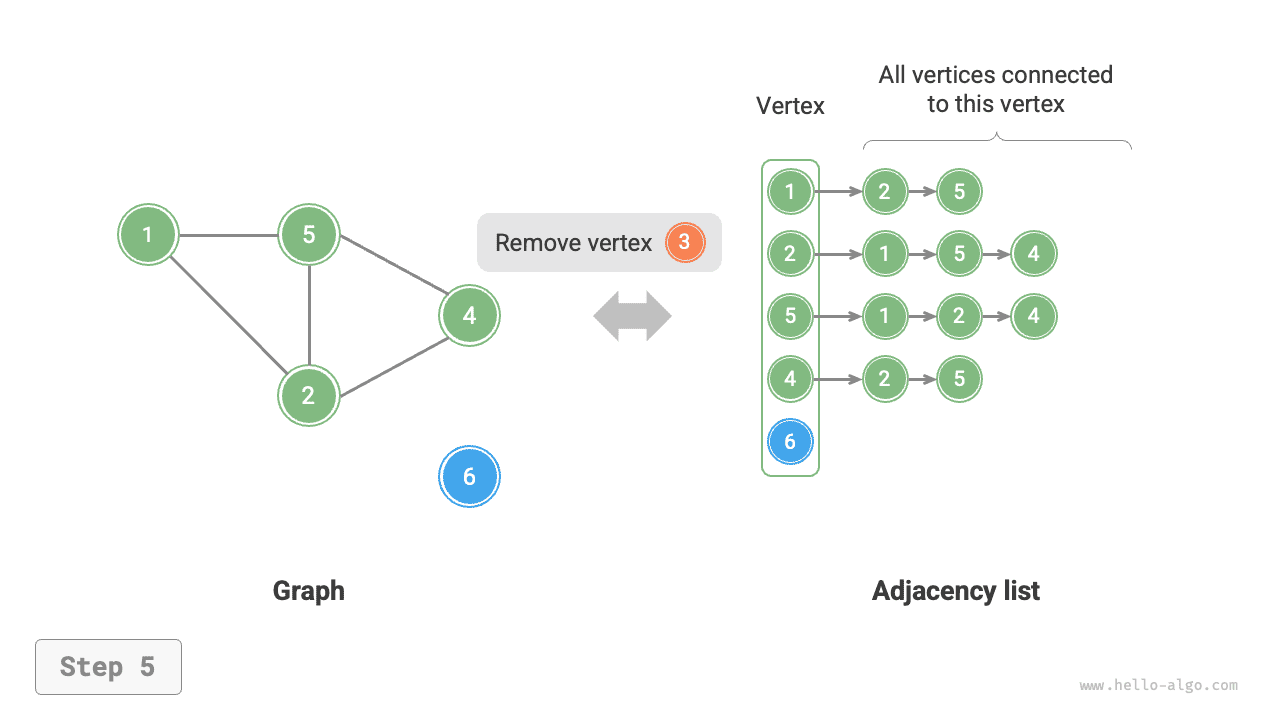
그림 9-8 인접 리스트의 초기화, 간선 추가와 삭제, 정점 추가와 삭제
다음은 인접 리스트의 구현 코드다. 위 그림(9-8)과 비교하면 실제 코드에는 다음 차이가 있다.
- 정점을 편리하게 추가하고 삭제하며 코드를 간단하게 만들기 위해 연결 리스트 대신 리스트(동적 배열)를 사용한다.
- 해시 테이블로 인접 리스트를 저장한다.
key는 정점 인스턴스이고,value는 그 정점의 인접 정점 리스트(연결 리스트)다.
또한 인접 리스트에서 정점을 나타내기 위해 Vertex 클래스를 사용한다. 인접 행렬처럼 리스트 인덱스로 정점을 구분한다면 인덱스가 \(i\)인 정점을 삭제할 때 인접 리스트 전체를 순회하면서 \(i\)보다 큰 모든 인덱스를 \(1\)씩 줄여야 하므로 매우 비효율적이기 때문이다. 반면 정점마다 고유한 Vertex 인스턴스를 사용하면 어느 정점을 삭제해도 다른 정점을 수정할 필요가 없다.
class GraphAdjList:
    """인접 리스트로 구현한 무방향 그래프 클래스"""

    def __init__(self, edges: list[list[Vertex]]):
        """생성자"""
        # 인접 리스트의 key: 정점, value: 해당 정점의 모든 인접 정점
        self.adj_list = dict[Vertex, list[Vertex]]()
        # 모든 정점과 간선을 추가한다
        for edge in edges:
            self.add_vertex(edge[0])
            self.add_vertex(edge[1])
            self.add_edge(edge[0], edge[1])

    def size(self) -> int:
        """정점 개수 반환"""
        return len(self.adj_list)

    def add_edge(self, vet1: Vertex, vet2: Vertex):
        """간선 추가"""
        if vet1 not in self.adj_list or vet2 not in self.adj_list or vet1 == vet2:
            raise ValueError()
        # 간선 vet1 - vet2를 추가한다
        self.adj_list[vet1].append(vet2)
        self.adj_list[vet2].append(vet1)

    def remove_edge(self, vet1: Vertex, vet2: Vertex):
        """간선 삭제"""
        if vet1 not in self.adj_list or vet2 not in self.adj_list or vet1 == vet2:
            raise ValueError()
        # 간선 vet1 - vet2를 삭제한다
        self.adj_list[vet1].remove(vet2)
        self.adj_list[vet2].remove(vet1)

    def add_vertex(self, vet: Vertex):
        """정점 추가"""
        if vet in self.adj_list:
            return
        # 인접 리스트에 새 연결 리스트를 추가한다
        self.adj_list[vet] = []

    def remove_vertex(self, vet: Vertex):
        """정점 삭제"""
        if vet not in self.adj_list:
            raise ValueError()
        # 인접 리스트에서 정점 vet에 해당하는 연결 리스트를 삭제한다
        self.adj_list.pop(vet)
        # 다른 정점의 연결 리스트를 순회하여 vet를 포함하는 모든 간선을 삭제한다
        for vertex in self.adj_list:
            if vet in self.adj_list[vertex]:
                self.adj_list[vertex].remove(vet)

    def print(self):
        """인접 리스트 출력"""
        print("인접 리스트 =")
        for vertex in self.adj_list:
            tmp = [v.val for v in self.adj_list[vertex]]
            print(f"{vertex.val}: {tmp},")
/* 인접 리스트로 구현한 무방향 그래프 클래스 */
class GraphAdjList {
  public:
    // 인접 리스트의 key: 정점, value: 해당 정점의 모든 인접 정점
    unordered_map<Vertex *, vector<Vertex *>> adjList;

    /* vector에서 지정한 노드 삭제 */
    void remove(vector<Vertex *> &vec, Vertex *vet) {
        for (int i = 0; i < vec.size(); i++) {
            if (vec[i] == vet) {
                vec.erase(vec.begin() + i);
                break;
            }
        }
    }

    /* 생성자 */
    GraphAdjList(const vector<vector<Vertex *>> &edges) {
        // 모든 정점과 간선을 추가한다
        for (const vector<Vertex *> &edge : edges) {
            addVertex(edge[0]);
            addVertex(edge[1]);
            addEdge(edge[0], edge[1]);
        }
    }

    /* 정점 개수 반환 */
    int size() {
        return adjList.size();
    }

    /* 간선 추가 */
    void addEdge(Vertex *vet1, Vertex *vet2) {
        if (!adjList.count(vet1) || !adjList.count(vet2) || vet1 == vet2)
            throw invalid_argument("정점이 존재하지 않는다");
        // 간선 vet1 - vet2를 추가한다
        adjList[vet1].push_back(vet2);
        adjList[vet2].push_back(vet1);
    }

    /* 간선 삭제 */
    void removeEdge(Vertex *vet1, Vertex *vet2) {
        if (!adjList.count(vet1) || !adjList.count(vet2) || vet1 == vet2)
            throw invalid_argument("정점이 존재하지 않는다");
        // 간선 vet1 - vet2를 삭제한다
        remove(adjList[vet1], vet2);
        remove(adjList[vet2], vet1);
    }

    /* 정점 추가 */
    void addVertex(Vertex *vet) {
        if (adjList.count(vet))
            return;
        // 인접 리스트에 새 연결 리스트를 추가한다
        adjList[vet] = vector<Vertex *>();
    }

    /* 정점 삭제 */
    void removeVertex(Vertex *vet) {
        if (!adjList.count(vet))
            throw invalid_argument("정점이 존재하지 않는다");
        // 인접 리스트에서 정점 vet에 해당하는 연결 리스트를 삭제한다
        adjList.erase(vet);
        // 다른 정점의 연결 리스트를 순회하여 vet를 포함하는 모든 간선을 삭제한다
        for (auto &adj : adjList) {
            remove(adj.second, vet);
        }
    }

    /* 인접 리스트 출력 */
    void print() {
        cout << "인접 리스트 =" << endl;
        for (auto &adj : adjList) {
            const auto &key = adj.first;
            const auto &vec = adj.second;
            cout << key->val << ": ";
            printVector(vetsToVals(vec));
        }
    }
};
/* 인접 리스트로 구현한 무방향 그래프 클래스 */
class GraphAdjList {
    // 인접 리스트의 key: 정점, value: 해당 정점의 모든 인접 정점
    Map<Vertex, List<Vertex>> adjList;

    /* 생성자 */
    public GraphAdjList(Vertex[][] edges) {
        this.adjList = new HashMap<>();
        // 모든 정점과 간선을 추가한다
        for (Vertex[] edge : edges) {
            addVertex(edge[0]);
            addVertex(edge[1]);
            addEdge(edge[0], edge[1]);
        }
    }

    /* 정점 개수 반환 */
    public int size() {
        return adjList.size();
    }

    /* 간선 추가 */
    public void addEdge(Vertex vet1, Vertex vet2) {
        if (!adjList.containsKey(vet1) || !adjList.containsKey(vet2) || vet1 == vet2)
            throw new IllegalArgumentException();
        // 간선 vet1 - vet2를 추가한다
        adjList.get(vet1).add(vet2);
        adjList.get(vet2).add(vet1);
    }

    /* 간선 삭제 */
    public void removeEdge(Vertex vet1, Vertex vet2) {
        if (!adjList.containsKey(vet1) || !adjList.containsKey(vet2) || vet1 == vet2)
            throw new IllegalArgumentException();
        // 간선 vet1 - vet2를 삭제한다
        adjList.get(vet1).remove(vet2);
        adjList.get(vet2).remove(vet1);
    }

    /* 정점 추가 */
    public void addVertex(Vertex vet) {
        if (adjList.containsKey(vet))
            return;
        // 인접 리스트에 새 연결 리스트를 추가한다
        adjList.put(vet, new ArrayList<>());
    }

    /* 정점 삭제 */
    public void removeVertex(Vertex vet) {
        if (!adjList.containsKey(vet))
            throw new IllegalArgumentException();
        // 인접 리스트에서 정점 vet에 해당하는 연결 리스트를 삭제한다
        adjList.remove(vet);
        // 다른 정점의 연결 리스트를 순회하여 vet를 포함하는 모든 간선을 삭제한다
        for (List<Vertex> list : adjList.values()) {
            list.remove(vet);
        }
    }

    /* 인접 리스트 출력 */
    public void print() {
        System.out.println("인접 리스트 =");
        for (Map.Entry<Vertex, List<Vertex>> pair : adjList.entrySet()) {
            List<Integer> tmp = new ArrayList<>();
            for (Vertex vertex : pair.getValue())
                tmp.add(vertex.val);
            System.out.println(pair.getKey().val + ": " + tmp + ",");
        }
    }
}
/* 인접 리스트로 구현한 무방향 그래프 클래스 */
class GraphAdjList {
    // 인접 리스트의 key: 정점, value: 해당 정점의 모든 인접 정점
    public Dictionary<Vertex, List<Vertex>> adjList;

    /* 생성자 */
    public GraphAdjList(Vertex[][] edges) {
        adjList = [];
        // 모든 정점과 간선을 추가한다
        foreach (Vertex[] edge in edges) {
            AddVertex(edge[0]);
            AddVertex(edge[1]);
            AddEdge(edge[0], edge[1]);
        }
    }

    /* 정점 개수 반환 */
    int Size() {
        return adjList.Count;
    }

    /* 간선 추가 */
    public void AddEdge(Vertex vet1, Vertex vet2) {
        if (!adjList.ContainsKey(vet1) || !adjList.ContainsKey(vet2) || vet1 == vet2)
            throw new InvalidOperationException();
        // 간선 vet1 - vet2를 추가한다
        adjList[vet1].Add(vet2);
        adjList[vet2].Add(vet1);
    }

    /* 간선 삭제 */
    public void RemoveEdge(Vertex vet1, Vertex vet2) {
        if (!adjList.ContainsKey(vet1) || !adjList.ContainsKey(vet2) || vet1 == vet2)
            throw new InvalidOperationException();
        // 간선 vet1 - vet2를 삭제한다
        adjList[vet1].Remove(vet2);
        adjList[vet2].Remove(vet1);
    }

    /* 정점 추가 */
    public void AddVertex(Vertex vet) {
        if (adjList.ContainsKey(vet))
            return;
        // 인접 리스트에 새 연결 리스트를 추가한다
        adjList.Add(vet, []);
    }

    /* 정점 삭제 */
    public void RemoveVertex(Vertex vet) {
        if (!adjList.ContainsKey(vet))
            throw new InvalidOperationException();
        // 인접 리스트에서 정점 vet에 해당하는 연결 리스트를 삭제한다
        adjList.Remove(vet);
        // 다른 정점의 연결 리스트를 순회하여 vet를 포함하는 모든 간선을 삭제한다
        foreach (List<Vertex> list in adjList.Values) {
            list.Remove(vet);
        }
    }

    /* 인접 리스트 출력 */
    public void Print() {
        Console.WriteLine("인접 리스트 =");
        foreach (KeyValuePair<Vertex, List<Vertex>> pair in adjList) {
            List<int> tmp = [];
            foreach (Vertex vertex in pair.Value)
                tmp.Add(vertex.val);
            Console.WriteLine(pair.Key.val + ": [" + string.Join(", ", tmp) + "],");
        }
    }
}
/* 인접 리스트로 구현한 무방향 그래프 클래스 */
type graphAdjList struct {
    // 인접 리스트의 key: 정점, value: 해당 정점의 모든 인접 정점
    adjList map[Vertex][]Vertex
}

/* 생성자 */
func newGraphAdjList(edges [][]Vertex) *graphAdjList {
    g := &graphAdjList{
        adjList: make(map[Vertex][]Vertex),
    }
    // 모든 정점과 간선을 추가한다
    for _, edge := range edges {
        g.addVertex(edge[0])
        g.addVertex(edge[1])
        g.addEdge(edge[0], edge[1])
    }
    return g
}

/* 정점 개수 반환 */
func (g *graphAdjList) size() int {
    return len(g.adjList)
}

/* 간선 추가 */
func (g *graphAdjList) addEdge(vet1 Vertex, vet2 Vertex) {
    _, ok1 := g.adjList[vet1]
    _, ok2 := g.adjList[vet2]
    if !ok1 || !ok2 || vet1 == vet2 {
        panic("오류")
    }
    // 간선 vet1 - vet2를 추가하고 익명 struct{}를 추가한다
    g.adjList[vet1] = append(g.adjList[vet1], vet2)
    g.adjList[vet2] = append(g.adjList[vet2], vet1)
}

/* 간선 삭제 */
func (g *graphAdjList) removeEdge(vet1 Vertex, vet2 Vertex) {
    _, ok1 := g.adjList[vet1]
    _, ok2 := g.adjList[vet2]
    if !ok1 || !ok2 || vet1 == vet2 {
        panic("오류")
    }
    // 간선 vet1 - vet2를 삭제한다
    g.adjList[vet1] = DeleteSliceElms(g.adjList[vet1], vet2)
    g.adjList[vet2] = DeleteSliceElms(g.adjList[vet2], vet1)
}

/* 정점 추가 */
func (g *graphAdjList) addVertex(vet Vertex) {
    _, ok := g.adjList[vet]
    if ok {
        return
    }
    // 인접 리스트에 새 연결 리스트를 추가한다
    g.adjList[vet] = make([]Vertex, 0)
}

/* 정점 삭제 */
func (g *graphAdjList) removeVertex(vet Vertex) {
    _, ok := g.adjList[vet]
    if !ok {
        panic("오류")
    }
    // 인접 리스트에서 정점 vet에 해당하는 연결 리스트를 삭제한다
    delete(g.adjList, vet)
    // 다른 정점의 연결 리스트를 순회하여 vet를 포함하는 모든 간선을 삭제한다
    for v, list := range g.adjList {
        g.adjList[v] = DeleteSliceElms(list, vet)
    }
}

/* 인접 리스트 출력 */
func (g *graphAdjList) print() {
    var builder strings.Builder
    fmt.Printf("인접 리스트 = \n")
    for k, v := range g.adjList {
        builder.WriteString("\t\t" + strconv.Itoa(k.Val) + ": ")
        for _, vet := range v {
            builder.WriteString(strconv.Itoa(vet.Val) + " ")
        }
        fmt.Println(builder.String())
        builder.Reset()
    }
}
/* 인접 리스트로 구현한 무방향 그래프 클래스 */
class GraphAdjList {
    // 인접 리스트의 key: 정점, value: 해당 정점의 모든 인접 정점
    public private(set) var adjList: [Vertex: [Vertex]]

    /* 생성자 */
    public init(edges: [[Vertex]]) {
        adjList = [:]
        // 모든 정점과 간선을 추가한다
        for edge in edges {
            addVertex(vet: edge[0])
            addVertex(vet: edge[1])
            addEdge(vet1: edge[0], vet2: edge[1])
        }
    }

    /* 정점 개수 반환 */
    public func size() -> Int {
        adjList.count
    }

    /* 간선 추가 */
    public func addEdge(vet1: Vertex, vet2: Vertex) {
        if adjList[vet1] == nil || adjList[vet2] == nil || vet1 == vet2 {
            fatalError("인수 오류")
        }
        // 간선 vet1 - vet2를 추가한다
        adjList[vet1]?.append(vet2)
        adjList[vet2]?.append(vet1)
    }

    /* 간선 삭제 */
    public func removeEdge(vet1: Vertex, vet2: Vertex) {
        if adjList[vet1] == nil || adjList[vet2] == nil || vet1 == vet2 {
            fatalError("인수 오류")
        }
        // 간선 vet1 - vet2를 삭제한다
        adjList[vet1]?.removeAll { $0 == vet2 }
        adjList[vet2]?.removeAll { $0 == vet1 }
    }

    /* 정점 추가 */
    public func addVertex(vet: Vertex) {
        if adjList[vet] != nil {
            return
        }
        // 인접 리스트에 새 연결 리스트를 추가한다
        adjList[vet] = []
    }

    /* 정점 삭제 */
    public func removeVertex(vet: Vertex) {
        if adjList[vet] == nil {
            fatalError("인수 오류")
        }
        // 인접 리스트에서 정점 vet에 해당하는 연결 리스트를 삭제한다
        adjList.removeValue(forKey: vet)
        // 다른 정점의 연결 리스트를 순회하여 vet를 포함하는 모든 간선을 삭제한다
        for key in adjList.keys {
            adjList[key]?.removeAll { $0 == vet }
        }
    }

    /* 인접 리스트 출력 */
    public func print() {
        Swift.print("인접 리스트 =")
        for (vertex, list) in adjList {
            let list = list.map { $0.val }
            Swift.print("\(vertex.val): \(list),")
        }
    }
}
/* 인접 리스트로 구현한 무방향 그래프 클래스 */
class GraphAdjList {
    // 인접 리스트의 key: 정점, value: 해당 정점의 모든 인접 정점
    adjList;

    /* 생성자 */
    constructor(edges) {
        this.adjList = new Map();
        // 모든 정점과 간선을 추가한다
        for (const edge of edges) {
            this.addVertex(edge[0]);
            this.addVertex(edge[1]);
            this.addEdge(edge[0], edge[1]);
        }
    }

    /* 정점 개수 반환 */
    size() {
        return this.adjList.size;
    }

    /* 간선 추가 */
    addEdge(vet1, vet2) {
        if (
            !this.adjList.has(vet1) ||
            !this.adjList.has(vet2) ||
            vet1 === vet2
        ) {
            throw new Error('잘못된 인수');
        }
        // 간선 vet1 - vet2를 추가한다
        this.adjList.get(vet1).push(vet2);
        this.adjList.get(vet2).push(vet1);
    }

    /* 간선 삭제 */
    removeEdge(vet1, vet2) {
        if (
            !this.adjList.has(vet1) ||
            !this.adjList.has(vet2) ||
            vet1 === vet2 ||
            this.adjList.get(vet1).indexOf(vet2) === -1
        ) {
            throw new Error('잘못된 인수');
        }
        // 간선 vet1 - vet2를 삭제한다
        this.adjList.get(vet1).splice(this.adjList.get(vet1).indexOf(vet2), 1);
        this.adjList.get(vet2).splice(this.adjList.get(vet2).indexOf(vet1), 1);
    }

    /* 정점 추가 */
    addVertex(vet) {
        if (this.adjList.has(vet)) return;
        // 인접 리스트에 새 연결 리스트를 추가한다
        this.adjList.set(vet, []);
    }

    /* 정점 삭제 */
    removeVertex(vet) {
        if (!this.adjList.has(vet)) {
            throw new Error('잘못된 인수');
        }
        // 인접 리스트에서 정점 vet에 해당하는 연결 리스트를 삭제한다
        this.adjList.delete(vet);
        // 다른 정점의 연결 리스트를 순회하여 vet를 포함하는 모든 간선을 삭제한다
        for (const set of this.adjList.values()) {
            const index = set.indexOf(vet);
            if (index > -1) {
                set.splice(index, 1);
            }
        }
    }

    /* 인접 리스트 출력 */
    print() {
        console.log('인접 리스트 =');
        for (const [key, value] of this.adjList) {
            const tmp = [];
            for (const vertex of value) {
                tmp.push(vertex.val);
            }
            console.log(key.val + ': ' + tmp.join());
        }
    }
}
/* 인접 리스트로 구현한 무방향 그래프 클래스 */
class GraphAdjList {
    // 인접 리스트의 key: 정점, value: 해당 정점의 모든 인접 정점
    adjList: Map<Vertex, Vertex[]>;

    /* 생성자 */
    constructor(edges: Vertex[][]) {
        this.adjList = new Map();
        // 모든 정점과 간선을 추가한다
        for (const edge of edges) {
            this.addVertex(edge[0]);
            this.addVertex(edge[1]);
            this.addEdge(edge[0], edge[1]);
        }
    }

    /* 정점 개수 반환 */
    size(): number {
        return this.adjList.size;
    }

    /* 간선 추가 */
    addEdge(vet1: Vertex, vet2: Vertex): void {
        if (
            !this.adjList.has(vet1) ||
            !this.adjList.has(vet2) ||
            vet1 === vet2
        ) {
            throw new Error('잘못된 인수');
        }
        // 간선 vet1 - vet2를 추가한다
        this.adjList.get(vet1).push(vet2);
        this.adjList.get(vet2).push(vet1);
    }

    /* 간선 삭제 */
    removeEdge(vet1: Vertex, vet2: Vertex): void {
        if (
            !this.adjList.has(vet1) ||
            !this.adjList.has(vet2) ||
            vet1 === vet2 ||
            this.adjList.get(vet1).indexOf(vet2) === -1
        ) {
            throw new Error('잘못된 인수');
        }
        // 간선 vet1 - vet2를 삭제한다
        this.adjList.get(vet1).splice(this.adjList.get(vet1).indexOf(vet2), 1);
        this.adjList.get(vet2).splice(this.adjList.get(vet2).indexOf(vet1), 1);
    }

    /* 정점 추가 */
    addVertex(vet: Vertex): void {
        if (this.adjList.has(vet)) return;
        // 인접 리스트에 새 연결 리스트를 추가한다
        this.adjList.set(vet, []);
    }

    /* 정점 삭제 */
    removeVertex(vet: Vertex): void {
        if (!this.adjList.has(vet)) {
            throw new Error('잘못된 인수');
        }
        // 인접 리스트에서 정점 vet에 해당하는 연결 리스트를 삭제한다
        this.adjList.delete(vet);
        // 다른 정점의 연결 리스트를 순회하여 vet를 포함하는 모든 간선을 삭제한다
        for (const set of this.adjList.values()) {
            const index: number = set.indexOf(vet);
            if (index > -1) {
                set.splice(index, 1);
            }
        }
    }

    /* 인접 리스트 출력 */
    print(): void {
        console.log('인접 리스트 =');
        for (const [key, value] of this.adjList.entries()) {
            const tmp = [];
            for (const vertex of value) {
                tmp.push(vertex.val);
            }
            console.log(key.val + ': ' + tmp.join());
        }
    }
}
/* 인접 리스트로 구현한 무방향 그래프 클래스 */
class GraphAdjList {
  // 인접 리스트의 key: 정점, value: 해당 정점의 모든 인접 정점
  Map<Vertex, List<Vertex>> adjList = {};

  /* 생성자 */
  GraphAdjList(List<List<Vertex>> edges) {
    for (List<Vertex> edge in edges) {
      addVertex(edge[0]);
      addVertex(edge[1]);
      addEdge(edge[0], edge[1]);
    }
  }

  /* 정점 개수 반환 */
  int size() {
    return adjList.length;
  }

  /* 간선 추가 */
  void addEdge(Vertex vet1, Vertex vet2) {
    if (!adjList.containsKey(vet1) ||
        !adjList.containsKey(vet2) ||
        vet1 == vet2) {
      throw ArgumentError;
    }
    // 간선 vet1 - vet2를 추가한다
    adjList[vet1]!.add(vet2);
    adjList[vet2]!.add(vet1);
  }

  /* 간선 삭제 */
  void removeEdge(Vertex vet1, Vertex vet2) {
    if (!adjList.containsKey(vet1) ||
        !adjList.containsKey(vet2) ||
        vet1 == vet2) {
      throw ArgumentError;
    }
    // 간선 vet1 - vet2를 삭제한다
    adjList[vet1]!.remove(vet2);
    adjList[vet2]!.remove(vet1);
  }

  /* 정점 추가 */
  void addVertex(Vertex vet) {
    if (adjList.containsKey(vet)) return;
    // 인접 리스트에 새 연결 리스트를 추가한다
    adjList[vet] = [];
  }

  /* 정점 삭제 */
  void removeVertex(Vertex vet) {
    if (!adjList.containsKey(vet)) {
      throw ArgumentError;
    }
    // 인접 리스트에서 정점 vet에 해당하는 연결 리스트를 삭제한다
    adjList.remove(vet);
    // 다른 정점의 연결 리스트를 순회하여 vet를 포함하는 모든 간선을 삭제한다
    adjList.forEach((key, value) {
      value.remove(vet);
    });
  }

  /* 인접 리스트 출력 */
  void printAdjList() {
    print("인접 리스트 =");
    adjList.forEach((key, value) {
      List<int> tmp = [];
      for (Vertex vertex in value) {
        tmp.add(vertex.val);
      }
      print("${key.val}: $tmp,");
    });
  }
}
/* 인접 리스트로 구현한 무방향 그래프 자료형 */
pub struct GraphAdjList {
    // 인접 리스트의 key: 정점, value: 해당 정점의 모든 인접 정점
    pub adj_list: HashMap<Vertex, Vec<Vertex>>, // 값 부분에는 HashSet<Vertex>가 더 적합할까?
}

impl GraphAdjList {
    /* 생성자 */
    pub fn new(edges: Vec<[Vertex; 2]>) -> Self {
        let mut graph = GraphAdjList {
            adj_list: HashMap::new(),
        };
        // 모든 정점과 간선을 추가한다
        for edge in edges {
            graph.add_vertex(edge[0]);
            graph.add_vertex(edge[1]);
            graph.add_edge(edge[0], edge[1]);
        }

        graph
    }

    /* 정점 개수 반환 */
    #[allow(unused)]
    pub fn size(&self) -> usize {
        self.adj_list.len()
    }

    /* 간선 추가 */
    pub fn add_edge(&mut self, vet1: Vertex, vet2: Vertex) {
        if vet1 == vet2 {
            panic!("값 오류");
        }
        // 간선 vet1 - vet2를 추가한다
        self.adj_list.entry(vet1).or_default().push(vet2);
        self.adj_list.entry(vet2).or_default().push(vet1);
    }

    /* 간선 삭제 */
    #[allow(unused)]
    pub fn remove_edge(&mut self, vet1: Vertex, vet2: Vertex) {
        if vet1 == vet2 {
            panic!("값 오류");
        }
        // 간선 vet1 - vet2를 삭제한다
        self.adj_list
            .entry(vet1)
            .and_modify(|v| v.retain(|&e| e != vet2));
        self.adj_list
            .entry(vet2)
            .and_modify(|v| v.retain(|&e| e != vet1));
    }

    /* 정점 추가 */
    pub fn add_vertex(&mut self, vet: Vertex) {
        if self.adj_list.contains_key(&vet) {
            return;
        }
        // 인접 리스트에 새 연결 리스트를 추가한다
        self.adj_list.insert(vet, vec![]);
    }

    /* 정점 삭제 */
    #[allow(unused)]
    pub fn remove_vertex(&mut self, vet: Vertex) {
        // 인접 리스트에서 정점 vet에 해당하는 연결 리스트를 삭제한다
        self.adj_list.remove(&vet);
        // 다른 정점의 연결 리스트를 순회하여 vet를 포함하는 모든 간선을 삭제한다
        for list in self.adj_list.values_mut() {
            list.retain(|&v| v != vet);
        }
    }

    /* 인접 리스트 출력 */
    pub fn print(&self) {
        println!("인접 리스트 =");
        for (vertex, list) in &self.adj_list {
            let list = list.iter().map(|vertex| vertex.val).collect::<Vec<i32>>();
            println!("{}: {:?},", vertex.val, list);
        }
    }
}
/* 노드 구조체 */
typedef struct AdjListNode {
    Vertex *vertex;           // 정점
    struct AdjListNode *next; // 다음 노드
} AdjListNode;

/* 정점에 해당하는 노드 찾기 */
AdjListNode *findNode(GraphAdjList *graph, Vertex *vet) {
    for (int i = 0; i < graph->size; i++) {
        if (graph->heads[i]->vertex == vet) {
            return graph->heads[i];
        }
    }
    return NULL;
}

/* 간선 추가 보조 함수 */
void addEdgeHelper(AdjListNode *head, Vertex *vet) {
    AdjListNode *node = (AdjListNode *)malloc(sizeof(AdjListNode));
    node->vertex = vet;
    // 맨 앞에 삽입한다
    node->next = head->next;
    head->next = node;
}

/* 간선 삭제 보조 함수 */
void removeEdgeHelper(AdjListNode *head, Vertex *vet) {
    AdjListNode *pre = head;
    AdjListNode *cur = head->next;
    // 연결 리스트에서 vet에 해당하는 노드를 찾는다
    while (cur != NULL && cur->vertex != vet) {
        pre = cur;
        cur = cur->next;
    }
    if (cur == NULL)
        return;
    // 연결 리스트에서 vet에 해당하는 노드를 삭제한다
    pre->next = cur->next;
    // 메모리 해제
    free(cur);
}

/* 인접 리스트로 구현한 무방향 그래프 클래스 */
typedef struct {
    AdjListNode *heads[MAX_SIZE]; // 노드 배열
    int size;                     // 노드 개수
} GraphAdjList;

/* 생성자 */
GraphAdjList *newGraphAdjList() {
    GraphAdjList *graph = (GraphAdjList *)malloc(sizeof(GraphAdjList));
    if (!graph) {
        return NULL;
    }
    graph->size = 0;
    for (int i = 0; i < MAX_SIZE; i++) {
        graph->heads[i] = NULL;
    }
    return graph;
}

/* 소멸자 */
void delGraphAdjList(GraphAdjList *graph) {
    for (int i = 0; i < graph->size; i++) {
        AdjListNode *cur = graph->heads[i];
        while (cur != NULL) {
            AdjListNode *next = cur->next;
            if (cur != graph->heads[i]) {
                free(cur);
            }
            cur = next;
        }
        free(graph->heads[i]->vertex);
        free(graph->heads[i]);
    }
    free(graph);
}

/* 정점에 해당하는 노드 찾기 */
AdjListNode *findNode(GraphAdjList *graph, Vertex *vet) {
    for (int i = 0; i < graph->size; i++) {
        if (graph->heads[i]->vertex == vet) {
            return graph->heads[i];
        }
    }
    return NULL;
}

/* 간선 추가 */
void addEdge(GraphAdjList *graph, Vertex *vet1, Vertex *vet2) {
    AdjListNode *head1 = findNode(graph, vet1);
    AdjListNode *head2 = findNode(graph, vet2);
    assert(head1 != NULL && head2 != NULL && head1 != head2);
    // 간선 vet1 - vet2를 추가한다
    addEdgeHelper(head1, vet2);
    addEdgeHelper(head2, vet1);
}

/* 간선 삭제 */
void removeEdge(GraphAdjList *graph, Vertex *vet1, Vertex *vet2) {
    AdjListNode *head1 = findNode(graph, vet1);
    AdjListNode *head2 = findNode(graph, vet2);
    assert(head1 != NULL && head2 != NULL);
    // 간선 vet1 - vet2를 삭제한다
    removeEdgeHelper(head1, head2->vertex);
    removeEdgeHelper(head2, head1->vertex);
}

/* 정점 추가 */
void addVertex(GraphAdjList *graph, Vertex *vet) {
    assert(graph != NULL && graph->size < MAX_SIZE);
    AdjListNode *head = (AdjListNode *)malloc(sizeof(AdjListNode));
    head->vertex = vet;
    head->next = NULL;
    // 인접 리스트에 새 연결 리스트를 추가한다
    graph->heads[graph->size++] = head;
}

/* 정점 삭제 */
void removeVertex(GraphAdjList *graph, Vertex *vet) {
    AdjListNode *node = findNode(graph, vet);
    assert(node != NULL);
    // 인접 리스트에서 정점 vet에 해당하는 연결 리스트를 삭제한다
    AdjListNode *cur = node, *pre = NULL;
    while (cur) {
        pre = cur;
        cur = cur->next;
        free(pre);
    }
    // 다른 정점의 연결 리스트를 순회하여 vet를 포함하는 모든 간선을 삭제한다
    for (int i = 0; i < graph->size; i++) {
        cur = graph->heads[i];
        pre = NULL;
        while (cur) {
            pre = cur;
            cur = cur->next;
            if (cur && cur->vertex == vet) {
                pre->next = cur->next;
                free(cur);
                break;
            }
        }
    }
    // 해당 정점 뒤의 정점을 앞으로 옮겨 빈자리를 채운다
    int i;
    for (i = 0; i < graph->size; i++) {
        if (graph->heads[i] == node)
            break;
    }
    for (int j = i; j < graph->size - 1; j++) {
        graph->heads[j] = graph->heads[j + 1];
    }
    graph->size--;
    free(vet);
}
/* 인접 리스트로 구현한 무방향 그래프 클래스 */
class GraphAdjList(edges: Array<Array<Vertex?>>) {
    // 인접 리스트의 key: 정점, value: 해당 정점의 모든 인접 정점
    val adjList = HashMap<Vertex, MutableList<Vertex>>()

    /* 생성자 */
    init {
        // 모든 정점과 간선을 추가한다
        for (edge in edges) {
            addVertex(edge[0]!!)
            addVertex(edge[1]!!)
            addEdge(edge[0]!!, edge[1]!!)
        }
    }

    /* 정점 개수 반환 */
    fun size(): Int {
        return adjList.size
    }

    /* 간선 추가 */
    fun addEdge(vet1: Vertex, vet2: Vertex) {
        if (!adjList.containsKey(vet1) || !adjList.containsKey(vet2) || vet1 == vet2)
            throw IllegalArgumentException()
        // 간선 vet1 - vet2를 추가한다
        adjList[vet1]?.add(vet2)
        adjList[vet2]?.add(vet1)
    }

    /* 간선 삭제 */
    fun removeEdge(vet1: Vertex, vet2: Vertex) {
        if (!adjList.containsKey(vet1) || !adjList.containsKey(vet2) || vet1 == vet2)
            throw IllegalArgumentException()
        // 간선 vet1 - vet2를 삭제한다
        adjList[vet1]?.remove(vet2)
        adjList[vet2]?.remove(vet1)
    }

    /* 정점 추가 */
    fun addVertex(vet: Vertex) {
        if (adjList.containsKey(vet))
            return
        // 인접 리스트에 새 연결 리스트를 추가한다
        adjList[vet] = mutableListOf()
    }

    /* 정점 삭제 */
    fun removeVertex(vet: Vertex) {
        if (!adjList.containsKey(vet))
            throw IllegalArgumentException()
        // 인접 리스트에서 정점 vet에 해당하는 연결 리스트를 삭제한다
        adjList.remove(vet)
        // 다른 정점의 연결 리스트를 순회하여 vet를 포함하는 모든 간선을 삭제한다
        for (list in adjList.values) {
            list.remove(vet)
        }
    }

    /* 인접 리스트 출력 */
    fun print() {
        println("인접 리스트 =")
        for (pair in adjList.entries) {
            val tmp = mutableListOf<Int>()
            for (vertex in pair.value) {
                tmp.add(vertex._val)
            }
            println("${pair.key._val}: $tmp,")
        }
    }
}
### 인접 리스트로 구현한 무방향 그래프 클래스 ###
class GraphAdjList
  attr_reader :adj_list

  ### 생성자 ###
  def initialize(edges)
    # 인접 리스트의 key: 정점, value: 해당 정점의 모든 인접 정점
    @adj_list = {}
    # 모든 정점과 간선을 추가한다
    for edge in edges
      add_vertex(edge[0])
      add_vertex(edge[1])
      add_edge(edge[0], edge[1])
    end
  end

  ### 정점 개수 반환 ###
  def size
    @adj_list.length
  end

  ### 간선 추가 ###
  def add_edge(vet1, vet2)
    raise ArgumentError if !@adj_list.include?(vet1) || !@adj_list.include?(vet2)

    @adj_list[vet1] << vet2
    @adj_list[vet2] << vet1
  end

  ### 간선 삭제 ###
  def remove_edge(vet1, vet2)
    raise ArgumentError if !@adj_list.include?(vet1) || !@adj_list.include?(vet2)

    # 간선 vet1 - vet2를 삭제한다
    @adj_list[vet1].delete(vet2)
    @adj_list[vet2].delete(vet1)
  end

  ### 정점 추가 ###
  def add_vertex(vet)
    return if @adj_list.include?(vet)

    # 인접 리스트에 새 연결 리스트를 추가한다
    @adj_list[vet] = []
  end

  ### 정점 삭제 ###
  def remove_vertex(vet)
    raise ArgumentError unless @adj_list.include?(vet)

    # 인접 리스트에서 정점 vet에 해당하는 연결 리스트를 삭제한다
    @adj_list.delete(vet)
    # 다른 정점의 연결 리스트를 순회하여 vet를 포함하는 모든 간선을 삭제한다
    for vertex in @adj_list
      @adj_list[vertex.first].delete(vet) if @adj_list[vertex.first].include?(vet)
    end
  end

  ### 인접 리스트 출력 ###
  def __print__
    puts '인접 리스트 ='
    for vertex in @adj_list
      tmp = @adj_list[vertex.first].map { |v| v.val }
      puts "#{vertex.first.val}: #{tmp},"
    end
  end
end
코드 시각화
9.2.3 효율 비교
그래프에 정점 \(n\) 개와 간선 \(m\) 개가 있다고 하자. 아래 표(9-2)는 인접 행렬과 인접 리스트의 시간 효율과 공간 효율을 비교한다. 여기서 인접 리스트(연결 리스트)는 이 절의 구현에 해당하며, 인접 리스트(해시 테이블)는 모든 연결 리스트를 해시 테이블로 바꾼 구현을 뜻한다.
표 9-2 인접 행렬과 인접 리스트 비교
| 인접 행렬 | 인접 리스트(연결 리스트) | 인접 리스트(해시 테이블) | |
|---|---|---|---|
| 인접 여부 확인 | \(O(1)\) | \(O(n)\) | \(O(1)\) |
| 간선 추가 | \(O(1)\) | \(O(1)\) | \(O(1)\) |
| 간선 삭제 | \(O(1)\) | \(O(n)\) | \(O(1)\) |
| 정점 추가 | \(O(n)\) | \(O(1)\) | \(O(1)\) |
| 정점 삭제 | \(O(n^2)\) | \(O(n + m)\) | \(O(n)\) |
| 메모리 사용량 | \(O(n^2)\) | \(O(n + m)\) | \(O(n + m)\) |
위 표(9-2)만 보면 인접 리스트(해시 테이블)의 시간 효율과 공간 효율이 가장 좋아 보인다. 하지만 실제로는 배열 접근이나 대입 한 번이면 되는 인접 행렬의 간선 연산이 더 효율적이다. 종합하면 인접 행렬은 '공간을 더 써서 시간을 절약하는' 원리를, 인접 리스트는 '시간을 더 써서 공간을 절약하는' 원리를 보여 준다.